


Where Manual Milling Machines Still Make Sense in Modern Workshops
Start with the jobs that actually land on the machine
A manual milling machine still earns its floor space when the work is irregular, low in volume, or simply too fluid for a programmed process to make sense. Technical evaluators usually know this in theory. The real question is where that line sits in practice.
If the workshop handles one-off fixtures, repair parts, rework, prototype brackets, maintenance modifications, or short test batches, manual milling often stays relevant longer than people expect. Not because it is faster in absolute terms, but because setup can be shorter, decisions can be made at the machine, and the operator can respond to material variation without stopping to revise a program.
That is the first check: look at the mix of parts, not the average monthly output. A shop may run mostly repeat work and still have enough interrupt-driven jobs to justify keeping manual capacity.
Use this checklist before ruling manual equipment out
- Are drawings stable? If dimensions, hole locations, or edge conditions change several times before release, manual milling can be the cleaner bridge between concept and frozen design.
- Is the batch small enough that programming time dominates? For a handful of parts, the cost is often in setup and proving out, not spindle time.
- Does the operator need to “feel” the cut? Thin sections, unknown material, salvage work, and repaired castings often benefit from direct operator control.
- Is tolerance selective rather than universal? Many parts only need tight control on a few features. A manual process can still be sensible when the rest is straightforward.
- Will the machine be used for support work? Tooling plates, clamp modifications, stops, jigs, and maintenance spares are classic reasons manual mills remain busy.
Shops make bad replacement decisions when they compare a manual mill to CNC on headline capability alone. Compare the actual workflow instead: print review, fixturing, setup changes, first-piece approval, operator availability, and interruption cost.
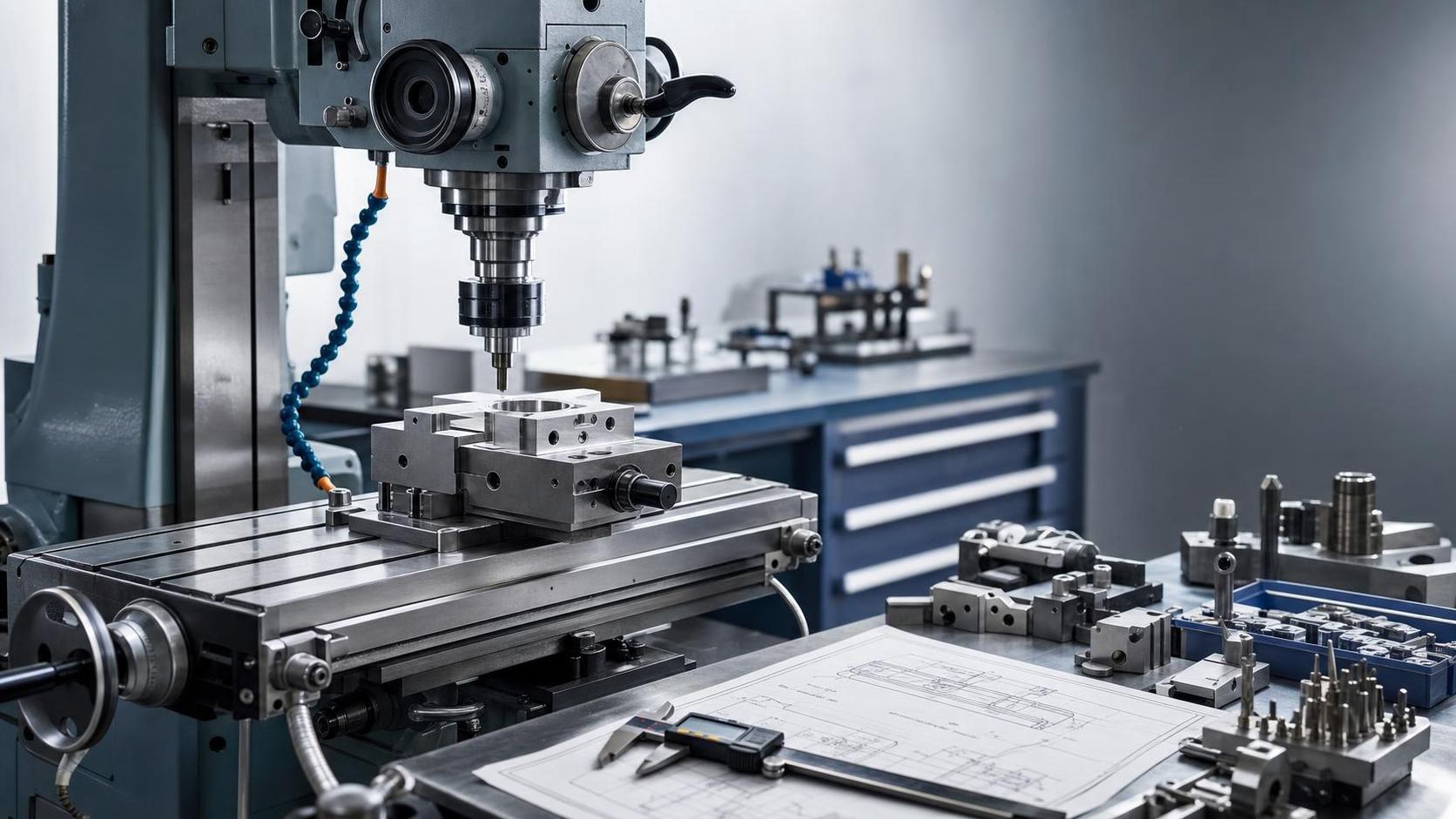
Where manual milling usually wins
Prototype work is the obvious case, but not the only one. In early-stage development, features move. Slots get widened, bosses get trimmed, hole patterns shift by a few millimeters. On a manual machine, that kind of revision is often handled with less administrative drag.
Repair work is another strong fit. When a worn keyway needs cleanup, a broken mounting face needs re-establishing, or a replacement component must match an old assembly that no longer has complete drawings, a manual setup gives the machinist room to indicate, inspect, adjust, and creep up on the result. That flexibility matters more than cycle time.
Training also belongs on the list. A technician who understands feeds, cutter behavior, backlash, workholding, and edge finding on a manual mill usually makes better process decisions later, even in a CNC-heavy environment. For evaluation teams, this is not sentiment. It affects skill development and troubleshooting depth on the shop floor.
Check the hidden costs, not just machine price
A manual milling machine is rarely chosen because it is more advanced. It is chosen because, in some workflows, it creates less overhead.
One warning: if a shop’s decision depends on squeezing repeatable output from operators with uneven skill levels, manual capacity can become a bottleneck fast. In that case, the machine may still have value, but its role should be support work, not production-critical throughput.
Look closely at feature complexity before deciding
A lot of borderline decisions become clear once you separate part complexity from part precision. Simple geometries with a few controlled dimensions are still good manual candidates. Complex contours, multi-face relationships, and repeatable high-density feature patterns usually are not.
That sounds obvious, but many evaluation errors come from parts that “look simple” until you review datum strategy, repositioning risk, and inspection burden. If the job requires several setups and every move stacks error, manual milling loses ground quickly. If the part can be completed in one or two straightforward operations with easy verification, it may remain perfectly rational.
Do not ignore adjacent processes
Evaluation should not happen in isolation. Workshops rarely buy or retain machines one category at a time. A manual mill often works alongside drilling, tapping, fitting, and bench assembly. That matters because some jobs are better solved by routing work to the right combination of simple machines rather than forcing everything through one automated platform.
For example, when large workpieces need flexible hole placement or variable reach, a radial drill may be a better companion than trying to make a mill cover every holemaking task. A machine such as Radial Drilling Machine Z3050 sits in that conversation because its envelope and drilling-focused layout answer a different question: up to 50 mm drilling capacity, 350-1600 mm spindle-to-column distance, 1250 mm horizontal headstock travel, and an arm swivel of ±180° give range that can reduce awkward setups on large parts. That does not replace a mill; it clarifies what the mill should and should not be asked to do.
What usually goes wrong in evaluation
Three mistakes show up again and again.
- Using average annual volume as the only filter. The outlier jobs are often the reason manual equipment survives.
- Underestimating response speed. When maintenance needs a part this afternoon, the fastest path is often the machine that can be set and cut immediately.
- Assuming manual means low precision by default. In reality, the limit depends on geometry, setup count, inspection method, and operator skill.
A better evaluation method is to pull a representative group of recent jobs and sort them by batch size, revision frequency, feature type, setup count, and urgency. That usually exposes where manual equipment is still carrying real operational value.
A practical way to decide
Start with the jobs that are painful, not the jobs that are glamorous. Review prototype parts, repair work, fixture changes, and urgent internal tooling first. Then check whether those jobs depend on quick setup, operator judgment, or direct part-to-part adjustment. If they do, manual milling still makes sense.
If most of the workload is stable, repetitive, and geometry-heavy, push those parts toward CNC and keep manual capacity focused on support roles. That is usually the cleanest split. The right decision is not whether manual is old or modern. It is whether the machine removes friction from the actual work your shop has to finish this week.
