


How CNC Machine Tools Improve Repeatability in Batch Production
Repeatability Is Not the Same as Accuracy
For batch production, the first question is rarely whether a machine can make one good part. The harder question is whether it can make the 30th, 300th, or 3,000th part with the same result. That is where CNC machine tools matter. In practical manufacturing terms, repeatability is the machine’s ability to return to the same commanded position and reproduce the same cutting conditions over repeated cycles. A process may be reasonably accurate on a single run and still perform poorly in batch work if thermal drift, clamping variation, tool wear, or unstable feed control start to move dimensions around.
Technical evaluators often see repeatability discussed alongside tolerance, surface finish, and machine rigidity, and that is appropriate because these factors are linked. A CNC platform improves repeatability not by one feature alone, but by combining closed-loop or tightly controlled motion, programmable feeds and speeds, stable structural design, and predictable workholding. In other words, it turns machining from an operator-dependent activity into a controlled production system.
Where Variation Usually Comes From
When batch consistency breaks down, the machine is only one part of the story. Variation usually comes from a stack of small shifts: backlash in motion components, spindle or blade deflection under changing load, inconsistent material support, hydraulic pressure fluctuation, tool wear compensation that is not updated, or programs that are technically correct but not robust enough for production conditions. CNC machine tools reduce these variables because the movement path, feed rate, cycle timing, and correction logic are defined in advance instead of being adjusted continuously by hand.
This is why the evaluation should move beyond catalog claims. Two machines may list similar travel ranges or cutting capacities, yet produce different batch results because one platform holds alignment better under load, reacts more consistently to thermal change, or maintains steadier clamping during repeated cycles. Repeatability is operational behavior, not just a specification line.
A useful way to assess this is to look at how the machine controls the variables that operators would otherwise have to correct manually:
- Axis positioning and return consistency
- Stability of spindle or blade speed under load
- Workpiece clamping repeatability
- Coolant delivery and heat management
- Ease of offset adjustment as tools wear
- Program consistency across shifts and operators
Why Programmable Control Changes Batch Performance
The real advantage of CNC control is not automation for its own sake. It is the repeatable execution of a defined process window. Once feed, speed, path, dwell, and sequencing are optimized for a given material and geometry, the machine can hold those conditions across the batch with far less operator variation. This matters especially in parts where dimension spread comes from inconsistent cutting force rather than from obvious setup mistakes.
In heavy-duty metal cutting, even an upstream sawing operation can affect downstream repeatability. If cut lengths vary, end squareness drifts, or clamping during cutting allows movement, later milling, drilling, or fixturing operations inherit that inconsistency. That is one reason evaluators should treat cutting preparation equipment as part of the repeatability chain, not as a separate purchasing category. A machine such as Band Saw Machine GH4250, with hydraulic workpiece clamping, multiple blade speeds, and a 500 x 500 mm cutting capacity, is relevant here because stable first-stage cutting reduces dimensional spread before precision machining even begins.
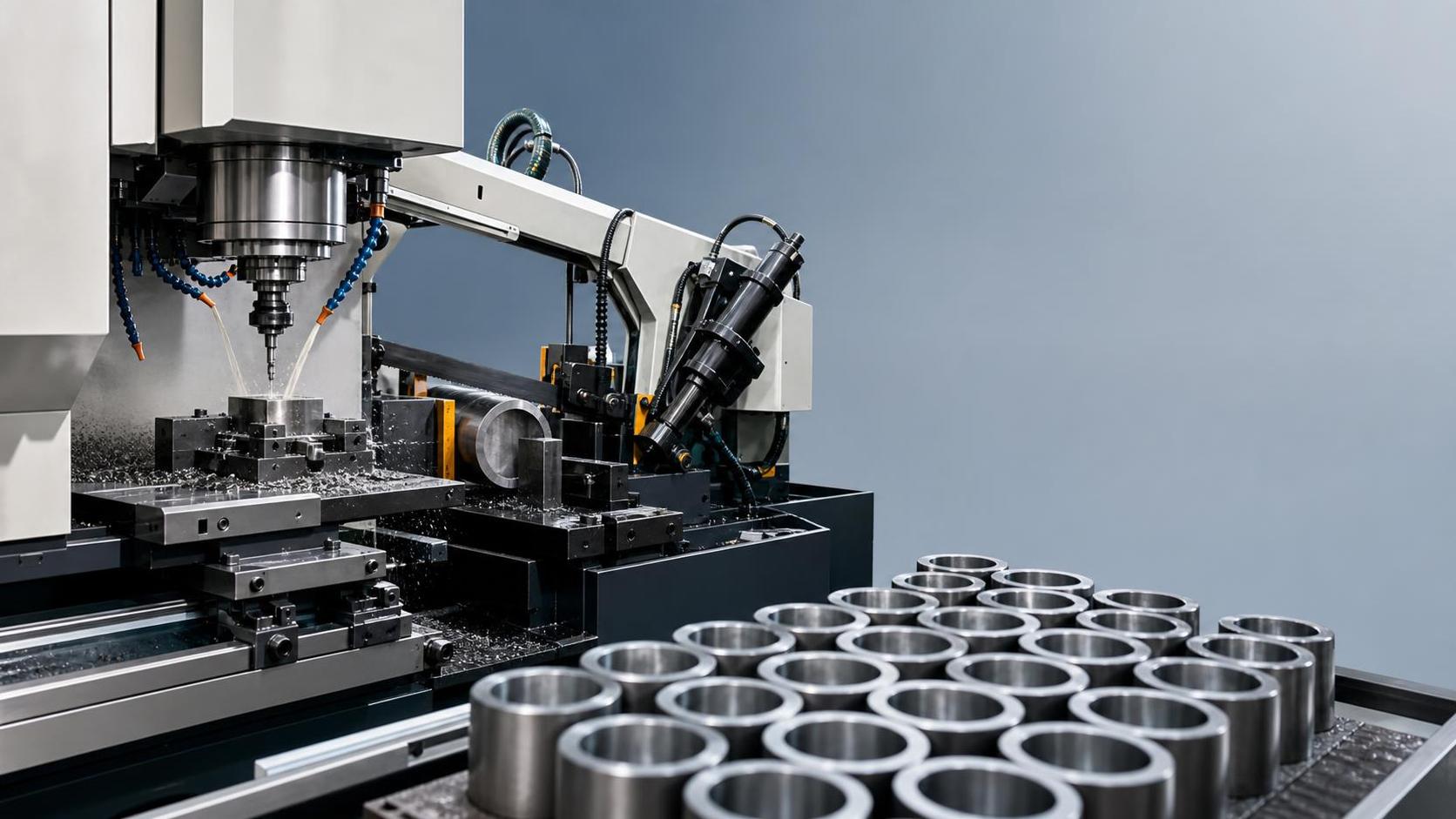
Repeatability Depends on the Whole Process Envelope
One common misunderstanding is to assume that a CNC machine automatically guarantees uniform output. It does not. It gives you the ability to build a repeatable process, but the result still depends on setup discipline, tool condition, fixture design, and how aggressively the machine is pushed relative to the material and geometry. A well-programmed machine with poor workholding will still produce unstable results. The same is true when a machine is selected mainly on peak capacity, while the actual job requires better low-vibration performance and tighter control of cut behavior.
This is where experienced buyers look at machine structure and support systems. Frame rigidity, guideway condition, drive response, hydraulic consistency, and coolant management all affect whether repeated cuts behave the same way. Even on simpler operations such as band sawing, repeatability is influenced by blade speed selection, material cross-section, and clamping stability. A machine with selectable blade speeds such as 27, 45, and 69 can be more useful than a one-speed platform when material mix changes, because it allows the process to stay closer to the correct cutting condition instead of forcing compromise settings across every batch.
What Technical Evaluators Should Actually Check
For an awareness-stage evaluation, the most reliable approach is to judge CNC machine tools by production behavior rather than by isolated feature lists. Ask what conditions the machine can keep stable over time and under load. Ask how repeatability is maintained when shifts change, raw material varies slightly, or tools begin to wear. Ask whether the control system and mechanical design make it easy to keep the process centered without constant manual intervention.
For suppliers serving precision engineering environments, this broader view is usually more meaningful than a narrow discussion of speed or output alone. Companies such as Shandong Honcan Machinery Equipment Co., Ltd., which work across CNC machine tools, intelligent manufacturing systems, and industrial cutting tools, are positioned around this exact issue: machine selection should support process consistency, not just nominal capability. That distinction matters because batch production rewards stability long before it rewards headline performance.
A Better Way to Read the Term “Improves Repeatability”
When a supplier says CNC machine tools improve repeatability, the serious interpretation is not that every machine will hold every tolerance equally well. It means the machine gives production teams a more controllable environment: defined motion, stable sequencing, reduced operator dependence, and better correction mechanisms when conditions begin to shift. That is what makes batch output more predictable.
For technical evaluation, the useful question is simple: does this equipment make the process easier to hold steady over a full run? If the answer depends on constant manual compensation, repeatability is weaker than it looks. If the machine can maintain clamping stability, cutting consistency, and program execution with limited intervention, then the improvement is real. Even support equipment such as Band Saw Machine GH4250 fits into that judgment when upstream cut quality influences everything that follows.
