


When the Universal milling machine X8126A suits low-volume repair work
For low-volume repair work, a Universal milling machine X8126A is most suitable when the workshop faces varied parts, uncertain rework requirements, and short turnaround windows rather than repeatable production batches. It earns its place when one machine must recover worn shafts, remake brackets, machine replacement covers, modify fixtures, cut keyways, or correct dimensions on components that cannot wait for an external machining supplier.
The fit becomes weaker when repair work is dominated by very large parts, tight multi-axis contouring, hardened materials that demand high metal-removal rates, or repeated jobs that could justify dedicated fixtures and CNC programming. Project managers should therefore assess the repair mix before treating a universal mill as a general answer to every maintenance problem.
Why flexibility matters more than cycle time in repair work
Repair machining rarely begins with a stable drawing and a known process. A part may arrive with damaged threads, an altered mounting face, corrosion around a bore, or a dimension that differs from the original documentation. The machinist often needs to inspect the component, establish usable reference surfaces, make a small corrective cut, and revise the setup before deciding on the final operation.
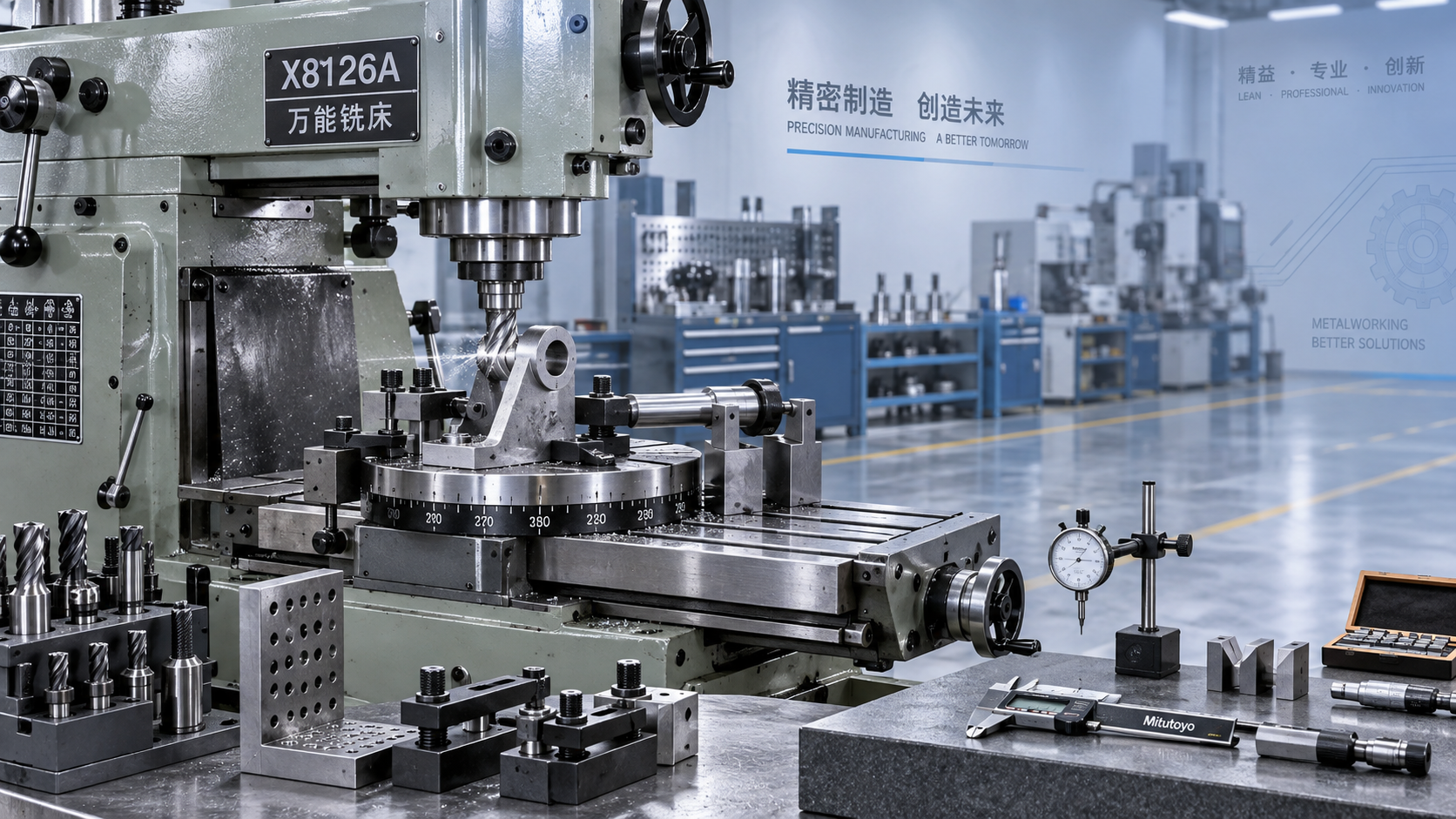
That is the environment in which the Universal milling machine X8126A can make sense. A universal table and adjustable spindle arrangement allow the operator to approach workpieces from different angles without relying on a dedicated production fixture. For a repair project, this can reduce the delay associated with moving a single component between several machines or waiting for a specialized setup to be prepared.
The value is not simply that the machine can perform many operations. It is that the machine can accommodate uncertainty. A repair team may start by milling a damaged face, then drill an offset hole, then machine a slot or keyway after the mating part has been checked. A flexible manual or semi-manual workflow is often easier to adapt at this stage than a process built around fixed tooling and fully optimized CNC cycle times.
Jobs that justify a universal mill
The strongest use case is a repair department with many different part families and relatively few repeats. Typical work includes restoring flat sealing faces, machining adapter plates, correcting fixture geometry, producing small replacement components, and modifying existing parts after an engineering change. It can also be useful where maintenance teams need to make one-off tooling, drilling guides, or locating blocks to support a larger repair.
- Parts are small to medium in size and can be clamped securely on the table.
- The required features include planes, slots, holes, shoulders, simple angular surfaces, or moderate contour work.
- Setup changes are frequent, while the quantity per job is low.
- Lead time matters more than achieving the lowest possible cost per piece.
- Skilled machinists are available to indicate, align, and verify irregular workpieces.
A universal machine is particularly useful when the repair itself is only one part of a wider shutdown or commissioning task. In that situation, the cost of waiting for a replacement part may exceed the cost difference between manual machining and a more automated process. The project benefit comes from recovering control over the schedule, provided the repair is technically acceptable and the work can be inspected properly.
Check the work envelope before focusing on versatility
“Universal” describes the machine configuration, not unlimited capacity. A project manager should begin with the heaviest, longest, and most awkward component likely to require repair. Table load, longitudinal travel, cross travel, vertical clearance, spindle-to-table distance, and the space required for clamps and angle plates all matter. A part that nominally fits within table dimensions may still be impractical if the cutter cannot reach the feature or if clamping blocks access to it.
Part geometry also determines whether swivel capability provides a real advantage. An angled face on a small gearbox bracket is a reasonable universal-mill task. A large, unbalanced casting that must be repositioned repeatedly may consume so much setup time that the supposed flexibility becomes a schedule risk. For these jobs, a horizontal boring machine, a larger bed mill, or subcontract machining may be the more predictable route.
For teams comparing capacity across universal machines, a configuration such as the Milling Machine X6436 illustrates the questions that should be asked: table load, available travel, table swivel range, spindle taper, spindle-speed range, and whether both vertical and horizontal spindle arrangements support the intended repair operations. Its stated 400 kg table load, 1,300 mm longitudinal travel, ISO50 spindle taper, and plus-or-minus 45-degree table swivel indicate a machine aimed at more substantial general machining work. Those figures are useful only when matched against the parts, fixtures, and cutters a specific repair program will use.
The hidden constraint is often setup, not cutting capacity
Low-volume repairs can look simple in a job description and become difficult once the part reaches the machine. The original datum surfaces may be worn or damaged. The component may not sit squarely because of cast ribs, irregular profiles, or attached features. A universal milling machine gives the operator more positioning options, but it does not create a reliable reference system by itself.
Before selecting the X8126A for a repair cell, establish how the team will handle the following:
- Indicating and aligning worn or non-machined surfaces.
- Holding irregular castings without distortion or unsafe overhang.
- Verifying hole locations and center distances after repositioning.
- Controlling angular features when the table or head is swiveled.
- Inspecting the finished repair against functional mating dimensions.
This is where accessory planning has more impact than many machine comparisons suggest. A vice alone will not cover repair work. The operating plan may require a rotary table, dividing head, angle plates, clamping kits, boring heads, collets, drill chucks, and suitable measuring equipment. Purchasing the base machine without considering those items can leave a workshop capable of routine milling but unable to complete the urgent, awkward jobs that motivated the investment.
When CNC may be the better repair choice
A conventional universal mill remains practical for one-off corrections and straightforward geometry, especially where an experienced machinist can work directly from the part and make controlled adjustments. It is less attractive when repair work requires repeated coordinate patterns, complex surfaces, traceable program control, or several identical replacement parts.
A CNC machining center may reduce risk where hole positions must be reproduced across multiple faces, where profiles are defined by digital models, or where the same repair is expected to recur. Yet CNC does not automatically eliminate setup effort. Irregular workholding, probing strategy, program preparation, and verification still take time. For a single urgent repair, the fastest route may be the machine that can accept the part, be aligned quickly, and be operated confidently by the available team.
The practical decision is therefore not manual versus CNC in the abstract. It is whether the expected variation in work outweighs the efficiency gained from automation. A Universal milling machine X8126A is a sound fit where the workshop needs broad capability for low quantities and can accept that accuracy depends heavily on setup discipline and operator skill.
Define the repair boundary before committing the machine
Some components can be restored safely by machining; others require engineering review, material restoration, heat treatment, or replacement. Milling away damage may reduce wall thickness, alter fit relationships, or affect a surface that carries fatigue loads. A machine tool selection cannot resolve those design questions.
For project planning, classify likely work into three groups: direct dimensional correction, repair requiring an engineered oversize or insert, and parts that should not be reworked without design approval. This avoids a common failure mode in urgent maintenance: choosing a flexible machine, completing an apparently clean repair, and discovering later that the component no longer meets its functional requirement.
The X8126A is best viewed as a controlled-response asset for diverse repair tasks. It is justified when the work is varied, the parts fit its real envelope, the workshop has the fixtures and measurement methods to establish reliable datums, and the repair scope has been defined before metal is removed. Under those conditions, its versatility can shorten the path from damaged component to usable replacement without the expense of building a dedicated production process.
