


Maintenance Costs to Review Before Buying a Gantry Machining Center
Which maintenance costs matter most before you buy a gantry machining center?
The purchase price is only the visible part of the budget. What usually changes the real ownership cost of a Gantry machining center is maintenance over the next three to five years. Procurement teams that miss this often end up comparing quotations that look similar at signing stage but behave very differently once the machine is on the floor.
The main cost buckets are predictable: spindle servicing, lubrication and coolant system upkeep, wear parts, tool magazine maintenance, electrical components, alignment checks, software or control support, and the cost of downtime while waiting for service or parts. A cheaper machine can become the expensive one if spare parts are slow to source or if preventive maintenance requires frequent stoppages.
For a buyer, the practical question is not “Does this machine need maintenance?” Every machine does. The real question is “How much maintenance is routine, how much is failure-driven, and how quickly can the supplier get me back into production?”
Is the spindle the biggest maintenance cost risk?
Very often, yes. The spindle is one of the most expensive assemblies to repair or replace, and it is also tightly linked to part quality. If a spindle starts showing vibration, thermal drift, unusual noise, or unstable surface finish, the cost is not limited to the repair invoice. You may also lose parts, cycle time, and delivery reliability.
When reviewing a supplier offer, ask for the maintenance schedule tied to spindle speed, taper type, and typical duty cycle. A machine running higher spindle speeds or heavy cutting loads may justify the productivity, but it should also come with a clear service interval and a documented path for spindle rebuilds, balancing, and replacement lead time.
If your production mix includes long shifts, aggressive roughing, or hard-to-machine materials, spindle risk deserves extra weight in your cost model.
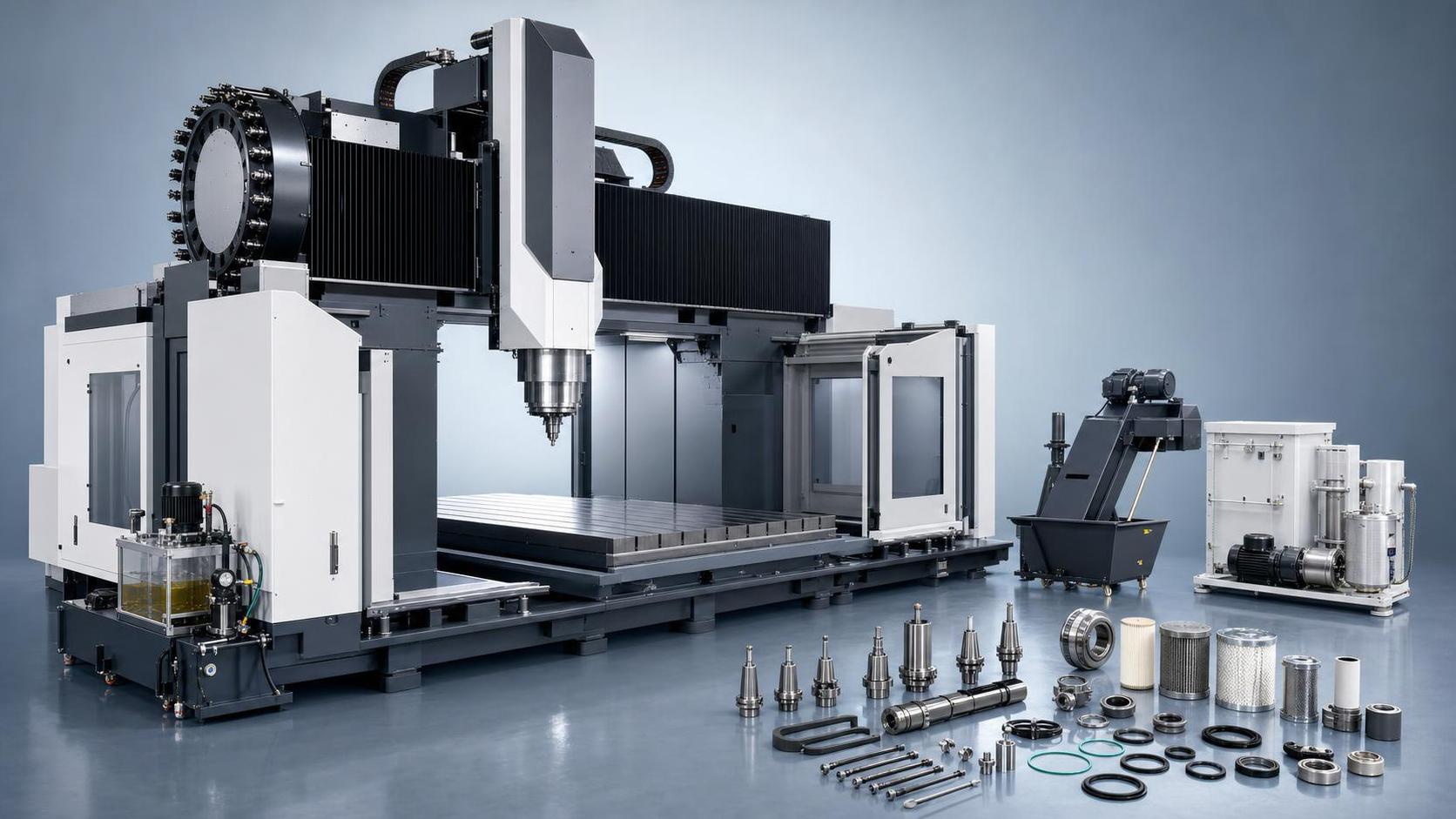
How should buyers evaluate lubrication, coolant, and chip management costs?
These systems do not attract much attention during negotiation, but they are constant cost drivers. Poor lubrication shortens guideway and ball screw life. Weak coolant management increases contamination, corrosion risk, and cleaning labor. Inadequate chip evacuation turns routine machining into repeated manual intervention.
Ask the supplier for the maintenance items that operators or maintenance staff must handle regularly:
- Lubricant type and refill interval
- Filter replacement frequency
- Coolant tank cleaning cycle
- Chip conveyor or chip removal service points
- Sensor cleaning requirements in dirty machining environments
This is where hidden labor appears. If a system needs frequent manual cleaning or adjustment, the machine may still perform well, but your maintenance overhead rises quietly every month.
Are spare parts costs more important than the machine's initial warranty?
In many purchasing decisions, yes. Warranty matters, but only for a limited period. Spare parts availability and pricing affect the machine for years. Buyers should request a recommended spare parts list before ordering and separate it into three groups: consumables, wear parts, and critical long-lead parts.
At minimum, review these points:
What documents should procurement request to estimate maintenance cost properly?
A quotation alone is not enough. You need the service and maintenance documents that show what the machine will demand after installation. Without them, maintenance forecasting becomes guesswork.
- Preventive maintenance schedule by daily, weekly, monthly, and annual tasks
- Recommended spare parts list with part categories
- Warranty scope and exclusions
- Service response terms, including remote and on-site support
- Installation requirements that affect future upkeep, such as air quality, power stability, and foundation conditions
- Operator and maintenance training content
This last point gets overlooked. Poor training usually shows up later as unnecessary alarm calls, tool changer issues, lubrication neglect, and shortened component life.
How do downtime and service response change the real cost of a Gantry machining center?
Downtime is often the largest maintenance-related expense, especially in plants where the machine supports bottleneck work. A repair that takes two days instead of eight hours can cost far more in missed output, overtime, and production reshuffling than the replacement part itself.
That is why buyers should ask not only whether service is available, but how it is delivered. Is remote diagnosis included? Are field technicians regional or overseas? Is there a parts escalation process for critical breakdowns? If the supplier cannot explain the path from alarm report to restored production, the maintenance risk is still undefined.
For procurement, this is a cost issue, not just a technical one.
Can machine configuration make maintenance easier or harder?
Absolutely. Configuration affects access, wear, and servicing time. Even within machining center families, the difference between one setup and another can change maintenance workload. For example, in industrial applications where buyers are also reviewing alternatives such as Horizontal machining center models, details like workbench count, indexing precision, spindle taper, and tool magazine capacity influence both productivity and upkeep.
A machine with 24 to 40 tool positions, spindle speeds up to 6000-10000 rpm, and workbench indexing of 1° or 0.001° may fit a demanding process well, but each of those choices should be reviewed from a maintenance angle too. More capability is valuable when it supports the process. It is less attractive when it adds complexity the plant does not actually use.
The right question is simple: are you paying to maintain features that your parts never need?
What are the most common maintenance-related buying mistakes?
A few mistakes show up repeatedly in machine tool procurement:
- Choosing on price alone and treating maintenance as a service department issue
- Ignoring parts lead times for critical assemblies
- Assuming warranty equals low lifetime cost
- Not checking what operator maintenance is required per shift
- Buying a higher-spec machine than the process needs
None of these mistakes look dramatic during tender review. They become visible later, when the machine is already committed and production has to live with the consequences.
What is a practical way to compare suppliers on maintenance cost?
Use a simple three-part scorecard: routine maintenance burden, breakdown recovery risk, and parts support. Give each supplier the same request list and compare what comes back. If one supplier provides a detailed schedule, named spare parts, response terms, and training scope while another only says “standard support,” that is already a meaningful cost signal.
The best purchasing decision usually comes from combining technical fit with service clarity. A Gantry machining center that matches the workpiece and can be maintained predictably is usually the safer buy than a lower-priced machine with vague after-sales support.
Before issuing the final purchase order, ask one last question: if this machine stops unexpectedly six months after installation, do we already know the likely cost, response path, and recovery time? If the answer is still fuzzy, the maintenance review is not finished.
