


When a Gantry Machining Center Is Better Than a Floor Type Mill
When a Gantry Machining Center Is Better Than a Floor Type Mill
The comparison is often framed too loosely. People say a floor type mill is more flexible, while a Gantry machining center is more rigid, and then stop there. That is not enough for equipment selection. In practice, the better choice depends on how the cutting forces travel through the structure, how the workpiece is supported, and how much positional stability the process needs over long machining cycles. If the job involves large plates, box structures, welded frames, molds, or long components with many distributed features on the top surface, a Gantry machining center often becomes the more reliable platform rather than just the more modern one.
The key advantage is structural symmetry. In a gantry machine, the bridge spans the work zone and the cutting head moves within a frame that is designed to keep deflection predictable. That matters when the part is wide, when tool overhang cannot be avoided, or when the program includes repeated heavy cuts followed by finishing passes. A floor type mill can absolutely machine large parts, especially when side access or very deep reach is required, but its layout tends to favor flexibility of approach over uniform rigidity across the whole envelope.
This is where technical evaluations often get clearer: ask not which machine is “more powerful,” but which machine keeps geometry under control when the part gets bigger and the process gets longer. For many large-format applications, the value of a Gantry machining center is not only in metal removal rate. It is in maintaining flatness, hole position, and surface consistency over a long travel range without forcing the programmer to compensate for machine behavior.
Where the gantry layout makes a measurable difference
A floor type mill is often chosen when the workpiece is very tall, awkward to clamp, or requires strong access to multiple faces. Its horizontal spindle arrangement can be a real advantage for deep cavity work, boring, and side-face machining on heavy structures. But when most critical features sit on the upper plane of a large part, a gantry machine usually has the cleaner load path. The table supports the work directly, the bridge controls the spindle from both sides, and the machine does not have to “reach into” the job in the same way.
That difference shows up in several common production situations:
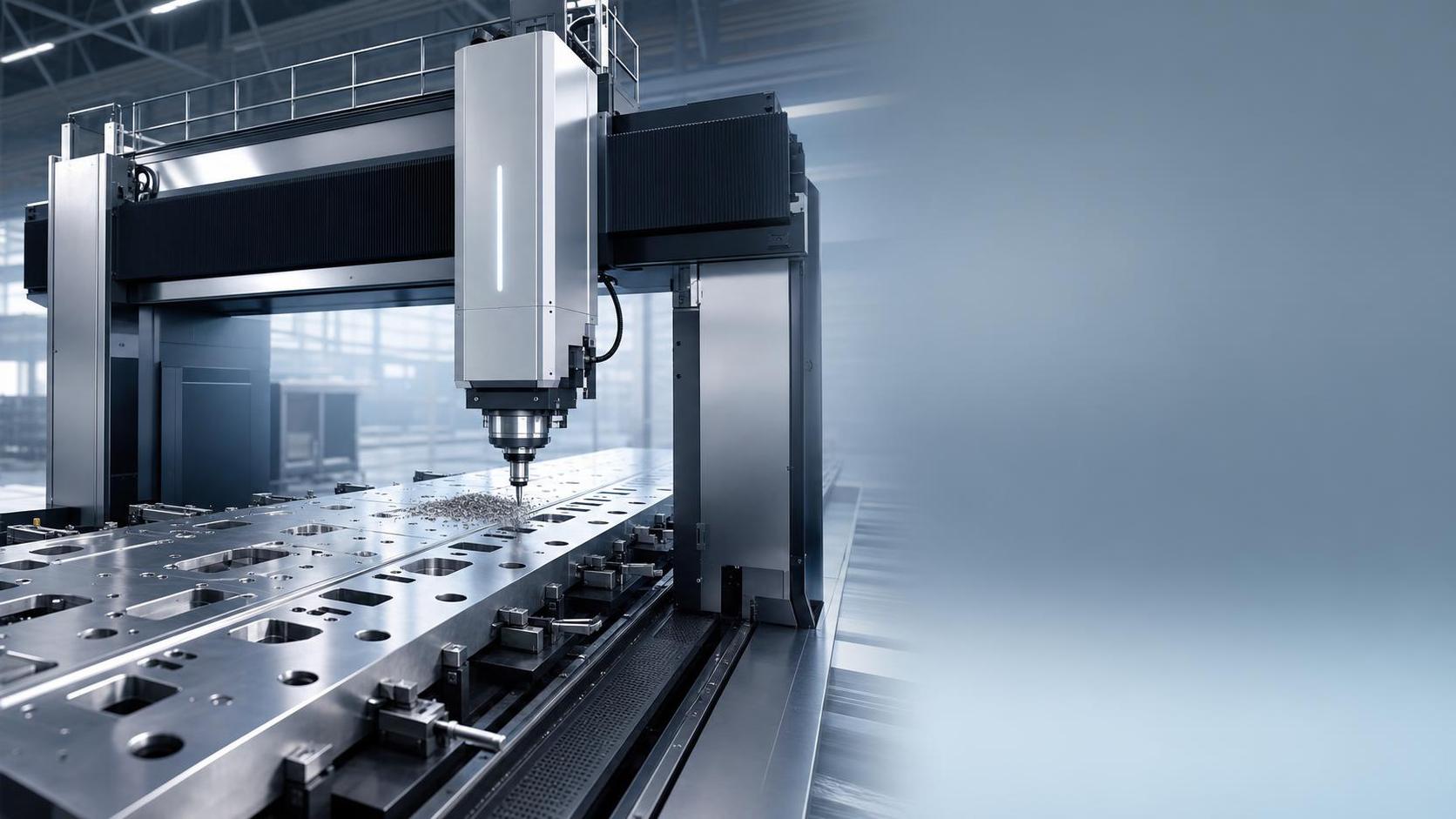
For technical evaluators, this usually matters more than brochure language. If the part family is dominated by bridge plates, machine bases, energy equipment structures, mold plates, or aerospace and shipbuilding panels, the question becomes whether the machine can hold process consistency over the entire component, not just whether it can physically reach the cutting area.
Rigidity is not the same as versatility
One common misunderstanding is that a floor type mill is automatically the better option for any large workpiece because it is associated with heavy-duty machining. That assumption ignores the nature of the feature set. If the job requires frequent side machining, deep boring, or work on multiple vertical faces with complex spindle orientation, the floor type design may be the more logical fit. But if the part is large mainly in length and width, and its critical tolerances are concentrated on the upper surface, versatility stops being the deciding factor.
Another mistake is to compare only spindle power or travel. Those numbers matter, but they do not explain how the machine behaves under real load. A technically sound comparison should include at least four practical questions: How is the part clamped and supported? Where are the tolerance-critical features located? Will the process mix roughing and finishing in one setup? How sensitive is the part to thermal drift or vibration over time? A Gantry machining center tends to score well when the answers point toward broad-surface accuracy and repeatability.
In real factory planning, that often affects downstream work as much as the cutting stage itself. A machine that leaves less variation in flatness or hole pattern can reduce manual fitting, rework, and alignment problems during assembly. That is especially relevant for industries where large fabricated components are later joined to precision subassemblies.
What to check during evaluation
When comparing machine types, it helps to evaluate the process, not just the machine architecture. Review the largest current part, but also the part family that will dominate spindle hours over the next few years. If most jobs need only occasional side access but consistently demand stable top-face machining, a gantry platform may deliver better overall utilization.
Look closely at these points during technical review:
- Whether tolerance-critical features are spread over a large planar area
- Whether the component is more wide than tall
- Whether one-setup machining is expected to replace multiple transfers
- Whether the process includes long finishing passes after aggressive roughing
- Whether fixture strategy favors a large table surface rather than side-mounted access
Shandong Honcan Machinery Equipment Co., Ltd. works in precision engineering and CNC equipment for customers facing exactly this kind of selection problem: not “which machine is bigger,” but which machine structure fits the production objective with fewer compromises. That distinction matters because an oversized or overly flexible solution can become expensive in ways the purchase specification does not immediately show.
Even in workshops focused on large machine tools, support equipment affects the same evaluation logic. For example, in fabrication, shipbuilding, aerospace preparation, or heavy metalworking, portable drilling tools may handle pre-machining or on-site operations before parts reach the main machining line. In that context, products such as Magnetic drill VD60 are used for localized drilling tasks where mobility and magnetic holding force matter more than full machining-center capability. It is a different class of equipment, but it underlines the same engineering principle: match the machine structure to the actual working condition, not to the broad category name.
A Gantry machining center is better than a floor type mill when the dominant challenge is keeping a large workpiece stable, accurate, and repeatable across a broad machining envelope. It is not universally better. It is better when the geometry of the part, the location of the critical features, and the process sequence all reward a more balanced and rigid top-down machining platform. That is the point where the comparison stops being theoretical and becomes useful for selection.
