




Is the Magnetic drill VD50 suitable for overhead drilling on steelwork?
Is the Magnetic Drill VD50 Suitable for Overhead Drilling on Steelwork?
The short answer is: potentially, but not by assumption. A Magnetic drill VD50 may be capable of working overhead on steelwork only when its magnetic base, motor arrangement, safety retention method, and stated operating position are suitable for that use. Drilling capacity alone does not answer the question. In overhead work, a drill that loses contact with the workpiece does not simply stop—it can fall, swing on its safety chain, damage surrounding equipment, or injure personnel below.
That distinction matters in fabrication shops, bridge maintenance, structural retrofits, plant shutdowns, and warehouse steelwork modifications. A magnetic drill can be extremely practical where access is limited and a conventional drill stand cannot be secured. But overhead drilling is one of the least forgiving magnetic-drill applications. The decision should be based on the actual steel surface and the complete working arrangement, not on the assumption that “the magnet is strong enough.”
What makes overhead use different?
On a vertical surface, gravity tends to pull the machine down along the steel. Overhead, gravity pulls directly away from the steel plate. The magnet must therefore resist the full suspended weight of the drill, plus vibration, cutter breakthrough forces, cable pull, coolant effects, and any sudden movement caused by an interrupted cut. If the base is not fully seated, the practical holding force can be far lower than the figure associated with ideal test conditions.
Magnetic holding performance is especially sensitive to conditions that are common on structural steel: thin members, uneven or curved surfaces, rust scale, heavy paint, weld spatter, gaps, and laminated or non-magnetic material. A drill may attach firmly to a clean, thick steel plate at bench height and still be unsuitable for a painted overhead flange in the field.
The condition of the steel is often the real deciding factor. Before a shift begins, the intended drilling point should be checked for thickness, flatness, surface contamination, and whether the material is actually ferromagnetic. Stainless steel, aluminium, galvanized assemblies with concealed layers, and steel sections with excessive coating build-up all require closer evaluation. Removing only enough coating to give the magnetic base direct, flat contact is usually preferable to trying to “force” a questionable setup.
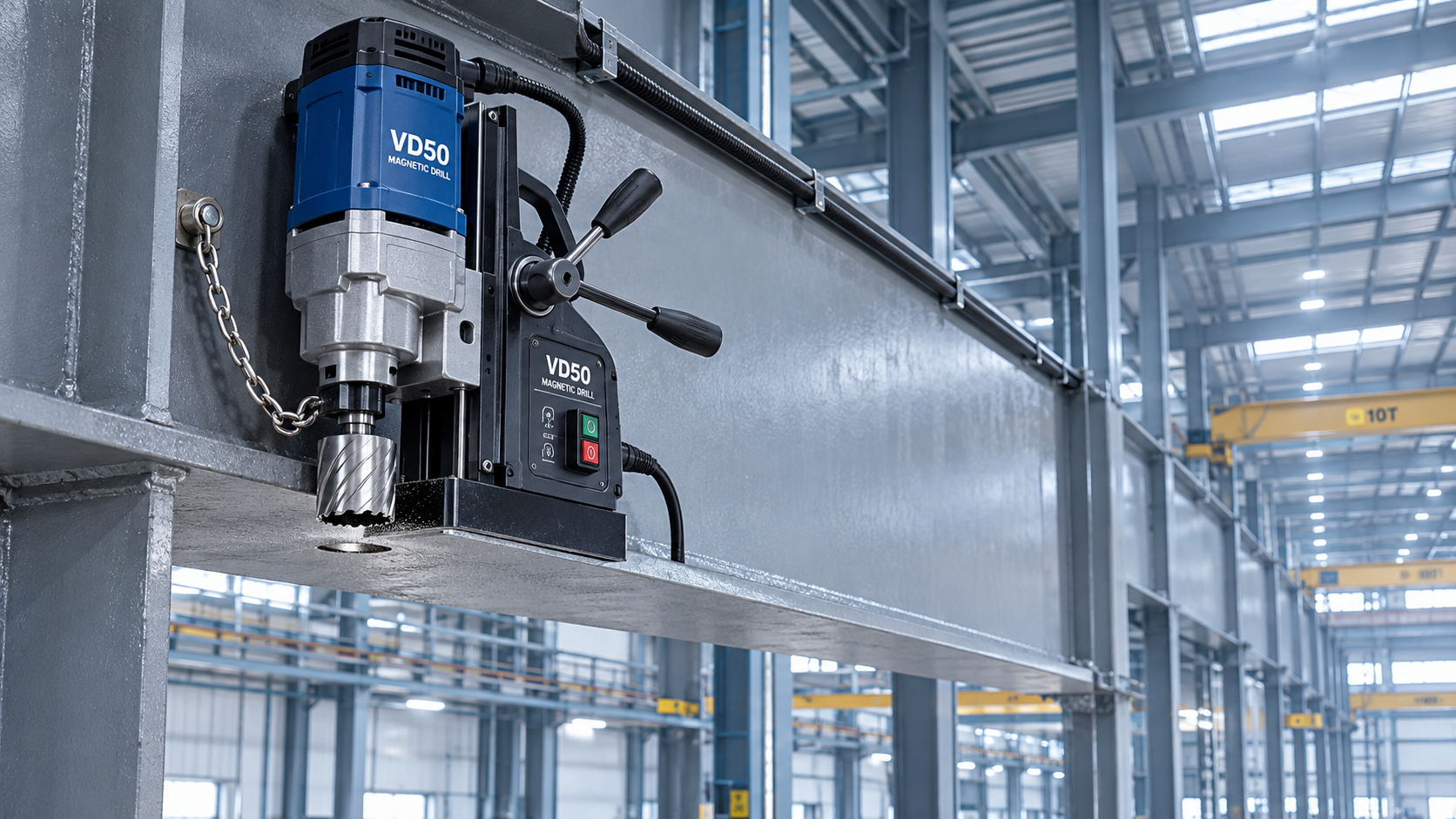
Do not treat the safety chain as a substitute for magnetic holding
A correctly fitted safety chain or strap is essential for overhead drilling, but it is a secondary restraint. It is intended to catch the machine if magnetic adhesion fails; it is not designed to hold the drill steady while cutting. If the chain is carrying load during normal operation, the setup is already wrong.
The restraint should be wrapped around a sound structural member, not clipped to thin handrail, conduit, cable tray, or a nearby bracket of unknown strength. It needs to be short enough to limit the drop distance, while still allowing the operator to position the drill without placing hands in the line of fall. This sounds obvious, yet loosely routed chains are a recurring weak point in field inspections. A falling drill can gain momentum before the chain arrests it, and that shock load may damage the restraint or the steel member used as an anchor point.
The power lead deserves similar attention. A hanging cable can create a sideways or peeling force at the magnetic base. Route it so that it is supported independently and cannot snag on scaffold tubes, sharp edges, or moving equipment. Where a drill is supplied with a low-voltage or enhanced safety power arrangement, it should be used in line with the equipment instructions rather than bypassed for convenience.
A practical go/no-go check for the VD50
The most defensible answer on a Magnetic drill VD50 is found in its manufacturer documentation. Confirm that overhead or upside-down operation is explicitly permitted for that exact model and configuration. If the manual limits the drill to horizontal or vertical use, it should not be deployed overhead simply because the base appears powerful. Equipment variants can look similar while having different magnet ratings, lubrication arrangements, motor protection features, or safety interlocks.
A useful pre-use review should cover the following points:
- Is the drilling surface clean, flat, magnetic, and sufficiently robust for the machine and cutting load?
- Does the magnetic base sit fully on the steel, without bridging welds, edges, holes, or curved transitions?
- Is a secondary restraint fitted to a verified structural anchor?
- Does the drill’s documentation permit the intended overhead position?
- Are the cutter, arbor, pilot pin, power cable, and controls in serviceable condition?
- Can an exclusion zone be maintained below the drilling position?
If any answer is uncertain, the correct response is not to proceed until the arrangement is reviewed. That may mean selecting a different drilling method, adding access equipment, changing the hole location, or using a dedicated fixture. Production pressure is not a technical control.
Cutting method matters as much as attachment
Even with secure magnetic contact, overhead drilling creates handling issues that are easy to underestimate. Annular cutters can produce a slug that drops when the cut breaks through. The drop zone must account for that slug as well as the drill itself. Operators should use appropriate eye and head protection and should never stand directly below the cutter. In confined plant areas, a simple barrier or controlled access zone is often more effective than relying on verbal warnings.
Coolant selection also needs thought. Flood coolant is rarely ideal overhead because it can run onto the operator, floor, electrical components, or process equipment. A suitable paste, gel, or other controlled lubrication method may be easier to manage, provided it is compatible with the cutter and the work procedure. Excess lubricant must not be allowed to contaminate the magnetic contact area.
Feed pressure should be steady rather than aggressive. Pushing too hard can increase vibration and raise the risk of cutter binding. When breakthrough is expected, reducing feed pressure helps avoid a sudden change in load. The operator also needs a stable working platform. Ladders are a poor match for an operation that requires two-handed control, close observation of the machine, and a safe escape path.
Where quality control should focus
For quality purposes, the hole is not acceptable merely because it is in the right approximate location. Overhead drilling can introduce poor alignment when the operator is working from an awkward angle or when the magnetic base is installed close to a flange edge. Inspect hole position, diameter, roundness where relevant, burr condition, and any damage to protective coatings around the opening. If the steelwork is part of a load-bearing or corrosion-protected assembly, the approved repair or coating process should be considered before drilling begins, not after the hole has been made.
It is also sensible to separate equipment inspection from task approval. A drill may pass a routine electrical and mechanical check while the planned work location remains unsuitable for magnetic drilling. That distinction prevents a common mistake: assuming that a serviceable machine automatically makes the method safe.
For operations evaluating several magnetic drill configurations, it can be helpful to compare a VD50 against machines intended for more controlled workshop drilling, such as Magnetic drill 8835. The comparison should focus on documented operating orientation, magnetic-base contact requirements, machine weight, cutter range, and restraint provisions—not simply on which model has the larger headline capacity.
A cautious decision is usually the efficient one
Shandong Honcan Machinery Equipment Co., Ltd. approaches industrial equipment selection around the practical relationship between machine capability, workpiece condition, and process reliability. That approach is particularly relevant here: a magnetic drill is a precision tool, but its safe performance depends on the entire installation rather than on the tool alone.
So, is the Magnetic drill VD50 suitable for overhead drilling on steelwork? It can be, provided the manufacturer authorizes that orientation and the job passes a site-specific assessment of steel condition, magnetic contact, secondary retention, operator access, power routing, and falling-object control. Where those conditions cannot be demonstrated, choosing another method is not over-cautious—it is the sound engineering decision.
