


How to compare Slant Bed CNC Lathe supplier quotes with different tooling
Supplier quotations for a slant bed CNC lathe often look comparable until the tooling line is examined closely. Two machines with similar swing, spindle power, and control brand can carry very different production capability once turret stations, driven tools, chucks, holders, probing, bar feeders, and setup support are included. A lower headline price may therefore represent a narrower machine package rather than a lower-cost solution.
For procurement teams, the practical objective is to convert every quote into a common operating scope: the same workpiece, material range, cycle-time expectation, staffing model, and required finished features. Only then can a Slant Bed CNC Lathe supplier quote be compared on a like-for-like basis.
Start with the part, not the machine specification
Before comparing supplier documents, define the production requirement in terms that can be priced consistently. A quote should be reviewed against representative parts rather than a general statement such as “turning steel components.” The supplier needs enough detail to determine whether the proposed tooling is sufficient for the intended work.
- Maximum and typical bar diameter or chucking diameter
- Part length, wall thickness, and workholding condition
- Materials to be machined, including difficult alloys or hardened sections
- Operations required in one setup: turning, grooving, threading, drilling, tapping, milling, cross drilling, or polygon machining
- Target tolerances, surface finish, and repeatability expectations
- Expected batch size, annual volume, and changeover frequency
This matters because a standard eight- or twelve-station turret may be adequate for a simple shaft, yet inadequate for a valve body or hydraulic fitting that requires several live-tool operations. One supplier may price a basic turning center and assume secondary drilling elsewhere; another may include a Y-axis, C-axis, live tooling, and angled holders so the part can be completed in one clamping. Their prices should not be treated as competing offers for the same solution.
A useful request-for-quotation practice is to issue a tooling matrix with the part drawing. Ask each supplier to mark every operation as included, identify the tool station used, and list any operation that remains external. This turns vague package descriptions into a production comparison.
Separate machine capacity from supplied tooling
Quotes commonly combine three different categories: machine capability, tooling interfaces, and the physical tools delivered with the machine. They should be evaluated separately.
Machine capability includes spindle power and torque, maximum speed, bar capacity, turret configuration, live-tool power, axis travel, tailstock or sub-spindle configuration, coolant arrangement, and chip handling. These determine what the lathe can potentially do.
Tooling interfaces include the turret mounting standard, bore sizes, VDI or BMT configuration, live-tool interface, collet system, chuck jaws, and quick-change arrangements. Interfaces define which holders and accessories can be installed later and how costly that expansion will be.
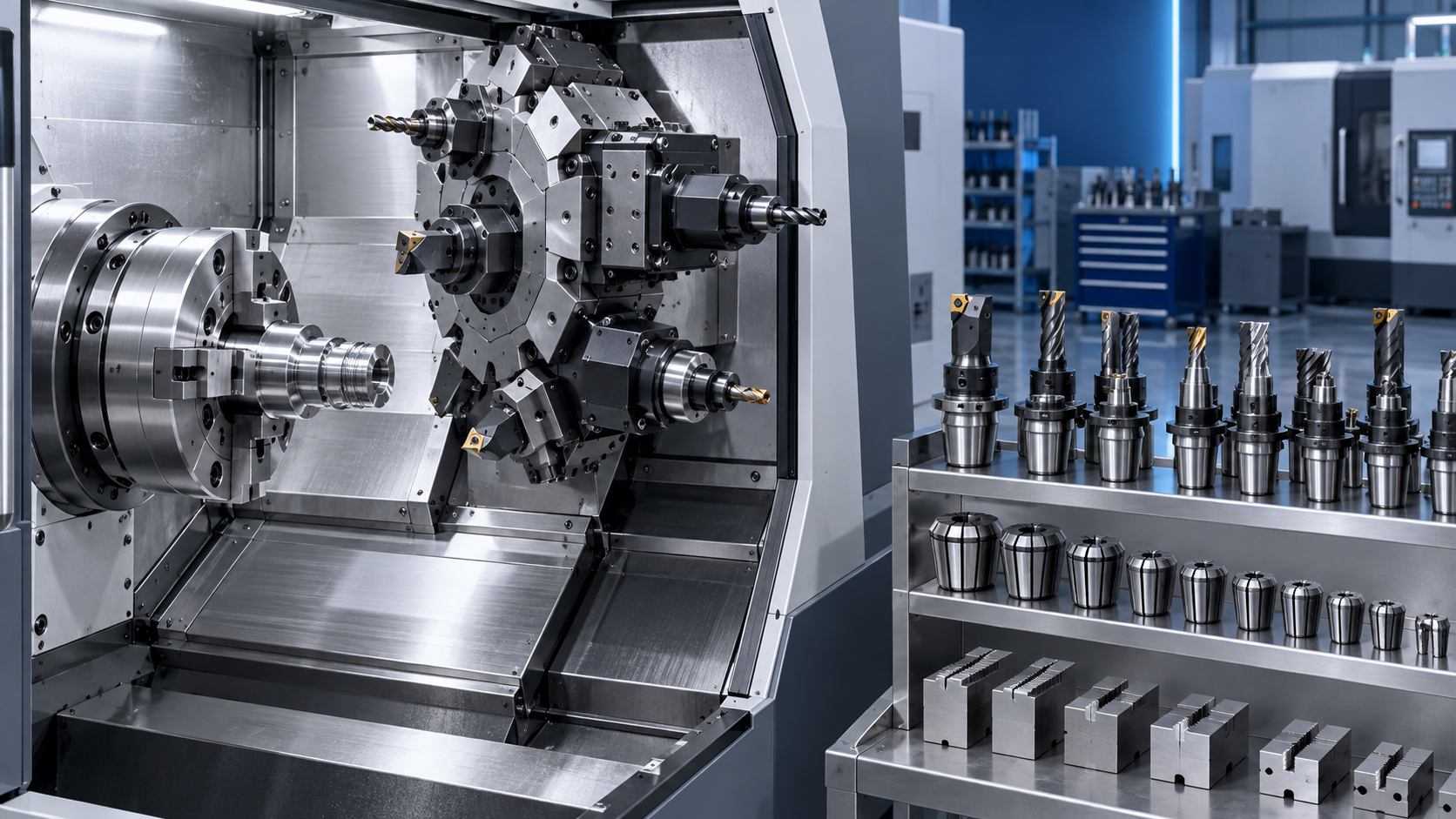
The supplied tooling package covers the holders, boring bar sleeves, turning tool blocks, driven tool holders, collets, drills, inserts, jaw sets, and measuring accessories actually delivered. A machine described as “live-tool ready” is not equivalent to one delivered with the live-tool holders required to run the part.
Request a line-by-line tooling schedule. “Standard tool package” should never be accepted as a sufficient description. The schedule should state quantity, station type, dimensions, brand where relevant, and whether cutting tools or inserts are included. For example, two radial live-tool holders may be included, while the part program requires four radial holders and two axial holders. The remaining purchase can be material, especially when a specific interface or premium holder manufacturer is required.
Tooling differences that change the real cost
Several quote differences deserve more attention than their line-item price might suggest.
Driven tooling and axis configuration
Live tooling adds more than the cost of the holder. It may require a C-axis, sufficient live-tool torque, appropriate transmission design, coolant delivery, and control functions for synchronized machining. A quote including only a C-axis should not be interpreted as a complete milling or cross-drilling package. Confirm live-tool speed, power, torque, holder orientation, and the number of holders included.
Similarly, a Y-axis can reduce setups for off-center features, but it introduces a different machine architecture and should be justified by the component family. For parts that need only axial drilling and tapping, a properly configured C-axis and axial holders may be the more economical route. For eccentric holes, flats, slots, or milling away from centerline, omitting the Y-axis can shift cost into fixtures and secondary operations.
Workholding is often under-scoped
Chuck size alone does not define a usable workholding package. Procurement should verify whether the quote includes a hydraulic chuck, soft jaws, hard jaws, draw tube, collet chuck, bar puller, parts catcher, and the machining or preparation needed for jaws. If thin-wall or irregular components are involved, the quotation should state whether special jaws, mandrels, or custom fixtures are excluded.
A low quote may include only a basic three-jaw chuck suitable for demonstration. That is acceptable when the buyer has an established internal tooling department and existing fixtures. It is less suitable when the machine is expected to enter production shortly after installation.
Tool presetting and measurement provisions
Tool setters, part probes, automatic tool measurement, and broken-tool detection affect both cycle stability and setup time. They are not mandatory on every lathe, but they should be evaluated against labor cost and batch pattern. High-mix work with frequent tool changes benefits from repeatable setup controls; a dedicated long-run application may rely on a simpler arrangement.
Ask suppliers to separate hardware price from software or parameter options. A probe may be physically installed while the required measurement cycles, interface options, or training are excluded. The quotation should make those boundaries visible.
Build a normalized quote sheet
Instead of comparing supplier totals, create a single internal sheet with a row for each production requirement. It should show included, optional, excluded, and assumed items. This also gives technical, production, and purchasing teams a shared basis for review.
This approach exposes a frequent issue: an option may be “available” but not priced, while another supplier includes it in the package. Do not classify both as equivalent simply because both machines can theoretically accept the same accessory.
Assess cost beyond the tooling invoice
Tooling price needs to be viewed alongside its effect on cycle time, setup labor, tool life, and secondary handling. A more complete package can be justified when it removes a separate operation, reduces operator intervention, or stabilizes a tolerance-sensitive process. Conversely, purchasing every optional holder at the machine-buy stage can tie up capital in tooling that will sit unused.
For a new component family, distinguish between “day-one tooling” and “future-capability tooling.” Day-one tooling is required to prove and produce the identified parts. Future-capability tooling supports possible work but should be priced separately, with interface compatibility confirmed. This preserves budget discipline without locking the buyer into an unsupported turret standard.
The same discipline applies to auxiliary equipment. A supplier may offer unrelated shop tools alongside the lathe package, such as a Magnetic drill VD332 for industrial drilling work. Such equipment may be useful for maintenance or fabrication, but it should be separated from the lathe’s production-cost evaluation. Its drilling capacity, magnetic holding requirement, and power supply needs answer a different operational question from the turning-cell investment.
Use acceptance terms to test the quoted configuration
The most reliable way to confirm whether tooling has been properly specified is to connect it to acceptance. Where practical, ask the supplier to machine a representative part or an agreed test piece using the quoted configuration. The acceptance document should identify material, starting condition, tooling responsibility, tolerances to be checked, and the measurement method.
Do not rely on an unloaded machine demonstration to validate a quote that includes complex tooling. A live-tool turning cycle, thread requirement, bore tolerance, or finish specification may reveal limits in holder reach, rigidity, coolant access, or programming support that are invisible in a basic runout check.
Also review the assumptions behind promised cycle time. Tool changes, loading, unloading, bar remnant handling, probing, chip clearing, and any manual intervention should be included where they occur in normal production. A fast cutting cycle is not the same as a fast finished-part cycle.
Choose the quote with the clearest production boundary
The strongest quotation is not necessarily the one with the longest option list. It is the one that clearly states what parts can be produced, what tooling is supplied to do so, what remains the buyer’s responsibility, and how the configuration will be accepted.
When competing quotes differ, ask each supplier to reprice against the same tooling matrix and acceptance scope before negotiating the final total. That step usually produces a more defensible procurement decision than pressing suppliers for a discount on packages that were never equivalent in the first place.
