


How Do You Maintain a CNC Cutting Machine for Longer Tool Life?
How to maintain a CNC cutting machine for longer tool life? It starts with a disciplined approach to daily inspection, proper lubrication, accurate calibration, and smart cutting parameter control. In modern manufacturing, consistent maintenance not only reduces unexpected downtime but also protects tool performance, improves cutting precision, and lowers operating costs. Understanding these essentials helps manufacturers extend machine life and achieve more reliable, efficient production.
For most manufacturers, the real issue is not whether maintenance matters, but which actions have the biggest effect on tool life, part quality, and machine uptime. The answer is straightforward: keep the machine mechanically stable, control heat and vibration, maintain clean lubrication and coolant systems, and make sure cutting conditions match the material and tooling.
When CNC cutting equipment is maintained only after obvious problems appear, tool wear usually accelerates first. Edge chipping, poor surface finish, dimensional drift, spindle overload, and irregular noise are often early warnings that the machine environment is shortening tool life long before a complete failure occurs.
This is why effective maintenance is not limited to replacing worn parts. It also includes inspection routines, operator discipline, parameter verification, and process consistency. A well-maintained CNC cutting machine supports longer tool life because the tool is no longer compensating for hidden machine instability or process variation.
Why does machine maintenance have such a direct impact on tool life?
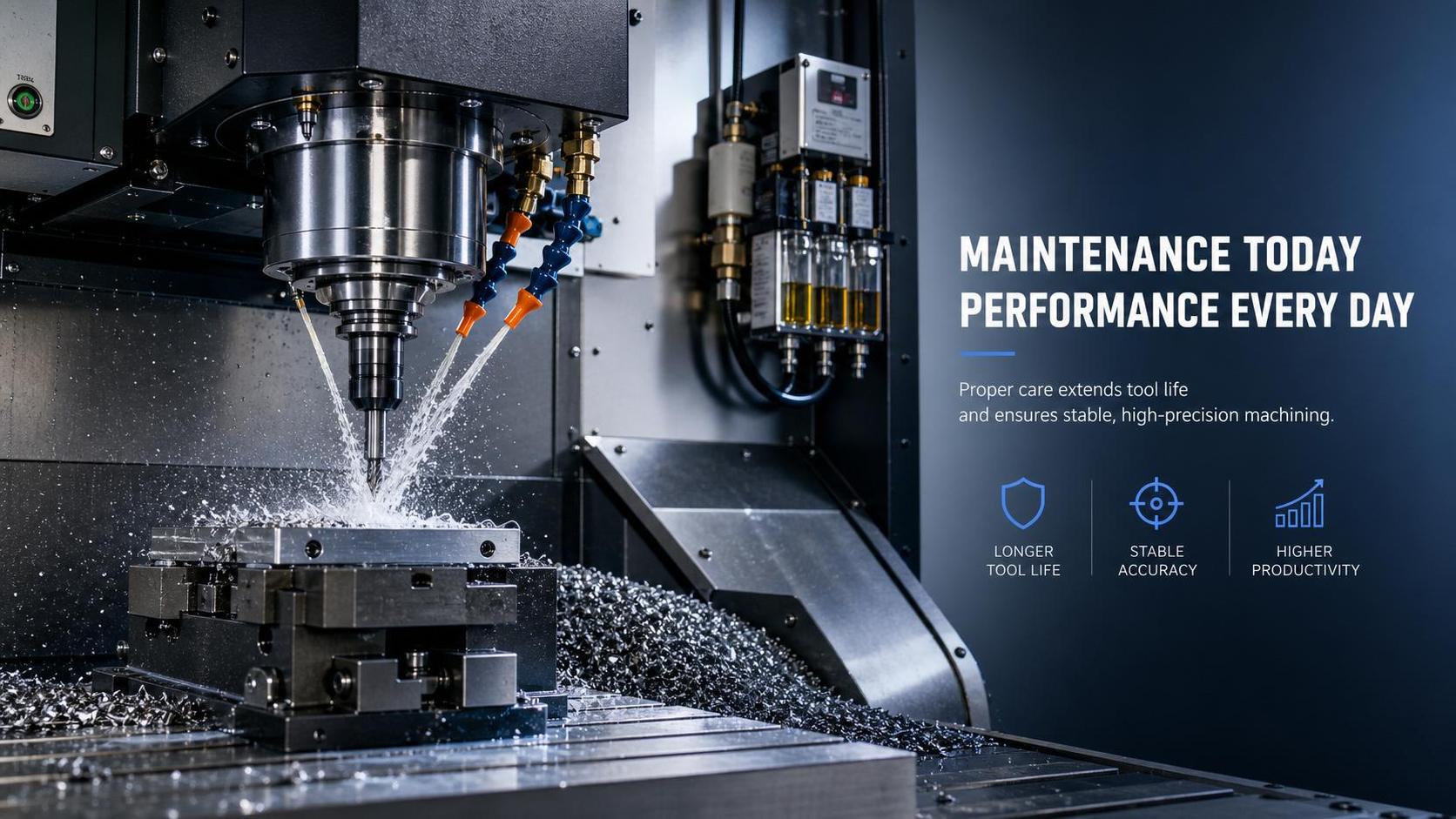
Many shops focus on the cutting tool itself when tool life drops, but the machine condition is often the deeper cause. A cutting edge performs best when spindle rotation is stable, axis movement is accurate, lubrication is consistent, and thermal distortion remains under control during production.
If any of these conditions drift, the tool experiences uneven cutting forces. That creates rubbing instead of clean cutting, generates excess heat, and increases vibration. Over time, even high-quality tools wear faster, break unpredictably, or produce inconsistent results that force more frequent tool changes.
In practical terms, better maintenance improves tool life because it preserves the environment the tool needs to work efficiently. It also reduces hidden costs such as scrap, rework, machine stoppages, and missed delivery schedules, which often matter more than the replacement cost of the tool itself.
Which daily maintenance checks matter most for longer CNC tool life?
Daily maintenance should focus on simple checks that prevent small issues from becoming process problems. Operators and maintenance staff should inspect the spindle area, tool holders, guideways, coolant flow, lubrication status, air pressure, and chip evacuation before and during production.
Start with cleanliness. Chips left around the tool magazine, spindle taper, workholding surfaces, or guide rails can affect alignment and create repeatability problems. Fine chips and dust are especially harmful because they can enter contact surfaces, reduce clamping accuracy, and contribute to premature wear.
Tool holders and spindle tapers should be kept clean and free from oil contamination, residue, or micro-damage. Even slight contamination can reduce clamping precision, increase runout, and create vibration during cutting. That vibration directly shortens tool life and can also damage the spindle interface over time.
Lubrication levels should be checked every day, not only when alarms appear. Low or contaminated lubrication increases friction on moving parts, reduces positioning smoothness, and may create subtle axis instability. These issues are not always immediately visible on the machine, but the cutting tool will reflect them quickly.
Coolant condition is equally important. Operators should verify coolant concentration, flow rate, nozzle direction, and cleanliness. If coolant does not reach the cutting zone consistently, heat builds rapidly at the tool edge. That leads to crater wear, thermal cracking, and poor chip control.
Air supply and pneumatic systems should also be monitored where applicable. Unstable air pressure can affect automatic tool changing, clamping, and auxiliary functions. Problems in these systems may seem separate from cutting performance, but they often contribute to tool seating errors or inconsistent machine operation.
How do lubrication and coolant management extend tool life?
Lubrication and coolant systems are central to CNC machine health because they control friction and temperature, two of the biggest drivers of tool wear. When either system is neglected, both the machine and the tool begin to lose performance in ways that compound over time.
Proper lubrication keeps guideways, ball screws, bearings, and transmission components moving smoothly. This helps the machine maintain axis accuracy and reduces sudden mechanical resistance. A stable motion system allows the tool to cut evenly, which lowers impact loading and prevents irregular edge breakdown.
Coolant performs several functions at once: it removes heat, flushes chips, improves surface finish, and reduces friction in the cut. To get these benefits, coolant must be correctly mixed, filtered, and delivered at the right pressure and angle for the application and material.
Dirty coolant is a common but underestimated cause of shorter tool life. Contaminated coolant may circulate abrasive particles back into the cutting zone, block nozzles, and encourage bacterial growth or chemical instability. This reduces cooling efficiency and can also damage pumps, seals, and internal passages.
Coolant concentration should be measured regularly rather than estimated visually. If concentration is too low, lubrication and corrosion protection suffer. If it is too high, residue may build up, heat transfer can change, and operating costs increase without delivering proportional cutting benefits.
For high-speed cutting or difficult materials, coolant delivery should be reviewed carefully. Poor nozzle positioning often means the coolant never reaches the actual heat source. In such cases, operators may blame the tool grade or cutting parameters when the real problem is ineffective coolant application.
How important are machine calibration and alignment for protecting cutting tools?
Calibration and alignment are critical because a sharp tool cannot compensate for a machine that cuts inaccurately. If spindle runout, axis backlash, squareness error, or tool change positioning drift beyond acceptable limits, the tool is forced into unstable engagement with the workpiece.
Spindle runout is especially important. Excessive runout means one section of the cutting edge removes more material than intended. That creates localized heat and uneven loading, which dramatically reduces tool life. In milling and drilling applications, runout often causes premature failure long before the tool is fully worn.
Axis backlash and servo inconsistency can also increase tool stress. When machine movement is not smooth or repeatable, the cutting edge experiences fluctuating chip loads. These variations are harmful because tools generally fail faster under shock and inconsistency than under steady, optimized cutting conditions.
Regular calibration should include checking spindle condition, axis positioning accuracy, tool setter performance, and workholding repeatability. Shops do not always need complex diagnostics every week, but they do need a schedule that matches production intensity, tolerance requirements, and machine age.
Alignment checks are particularly important after machine relocation, collision events, heavy overload, or repeated dimensional complaints. If tool wear suddenly increases across multiple jobs, it is often more efficient to verify machine geometry first than to continue changing tools and parameters without evidence.
Can cutting parameters and operator habits shorten tool life even on a well-maintained machine?
Yes. A well-maintained machine still requires correct operating practice. Tool life depends on the interaction between machine condition, material, tool grade, workholding, and cutting parameters. If feed, speed, depth of cut, or entry strategy are poorly matched, tools will wear faster despite good maintenance.
One common mistake is increasing spindle speed to improve output without checking thermal load and chip evacuation. Another is reducing feed too much, which may cause rubbing instead of cutting. Both situations create unnecessary heat and accelerate wear, even though the machine itself may be in good condition.
Operators should also pay attention to warm-up routines, especially on machines working to tighter tolerances. Starting high-precision cutting before the spindle and axes reach stable operating conditions can affect dimensional consistency and increase tool stress during the first production cycle.
Tool setup discipline matters as well. Incorrect tool projection, poor holder selection, weak clamping, and inconsistent presetting can all create vibration or deflection. In many cases, what appears to be a tooling problem is really a setup problem that maintenance and process control should address together.
Training should include recognizing early signs of tool wear and machine instability. Operators who can identify unusual sound, chip color changes, surface finish decline, or repeated offset corrections provide valuable early warning. Their observations often prevent major downtime and reduce unnecessary tool consumption.
What preventive maintenance schedule works best for CNC cutting machines?
A useful preventive maintenance schedule is layered by frequency: daily, weekly, monthly, and quarterly tasks. The goal is to catch wear patterns early and protect process stability before they affect production. The exact schedule should reflect machine usage, material type, and operating environment.
Daily tasks should include cleaning, checking lubrication and coolant levels, inspecting holders and tapers, confirming chip removal, and listening for unusual noise. Weekly tasks can include deeper cleaning of filters, checking coolant concentration, inspecting hoses and nozzles, and reviewing alarm history.
Monthly maintenance often includes checking belt tension where relevant, inspecting way covers, verifying fasteners, reviewing spindle condition, and checking air and hydraulic systems. It is also a good time to compare current cutting performance against baseline expectations for tool life and part quality.
Quarterly or scheduled service intervals should cover calibration checks, backlash verification, alignment review, electrical inspection, and broader system diagnostics. Machines running high-volume production or difficult materials may require these checks more frequently because the wear rate is typically higher.
Documentation is essential. A maintenance log helps teams connect machine condition with tool life trends, scrap rates, and downtime events. Without records, many shops repeat the same troubleshooting cycle because they cannot clearly see when a coolant issue, alignment drift, or lubrication problem first started.
Which warning signs suggest your CNC machine is already reducing tool life?
Several warning signs indicate that the machine may be damaging tools before operators realize it. These include rising tool consumption, inconsistent part finish, burr formation, dimensional variation, chatter marks, spindle vibration, abnormal heat, and more frequent offset adjustments during similar production runs.
Another sign is when tools from different suppliers or grades all perform below expectation on the same machine. If multiple tools fail in similar ways, the issue is less likely to be the tool brand alone and more likely to involve machine condition, setup rigidity, or coolant performance.
Unusual chip shape or color can also reveal maintenance-related issues. Blue or burnt chips may indicate excessive heat, while stringy chips may point to poor evacuation or parameter mismatch. These symptoms should trigger inspection of both process settings and supporting machine systems.
Repeated minor crashes, rough automatic tool changes, or visible taper marks should never be ignored. Even when the machine appears to keep running, these events can damage alignment, holders, and spindle interfaces. The result is often a gradual but expensive decline in tool life and cutting accuracy.
How can manufacturers balance maintenance cost with productivity and tool savings?
Some companies delay maintenance because they want to maximize production hours, but this usually creates higher total cost. Reactive maintenance tends to be more expensive than preventive maintenance because it combines emergency downtime, lost output, scrap, rushed repairs, and accelerated tool consumption.
The better approach is to measure maintenance as a productivity investment. If a small amount of scheduled downtime improves tool life, stabilizes quality, and avoids spindle or axis damage, the financial return is typically strong. This is especially true in shops with tight delivery timelines or expensive materials.
Managers should track indicators such as tool life consistency, machine utilization, part rejection rate, maintenance frequency, and mean time between failures. These metrics help show whether maintenance routines are truly supporting production efficiency or whether hidden instability still exists in the process.
For businesses using advanced CNC machine tools and industrial cutting systems, the greatest value often comes from integrating machine maintenance with tooling strategy, operator training, and process optimization. That combination produces the most reliable gains in uptime, precision, and overall equipment performance.
Final thoughts on how to maintain CNC cutting machine for longer tool life
If you want longer tool life, start by treating CNC maintenance as part of the cutting process rather than a separate service task. Cleanliness, lubrication, coolant quality, calibration, alignment, and disciplined setup all influence how efficiently a tool can cut and how long it will last.
The most effective strategy is consistent preventive maintenance supported by operator awareness and regular performance review. When the machine remains stable, the tool sees less heat, less vibration, and more predictable cutting loads. That leads to better part quality, lower tooling cost, and more dependable production.
For manufacturers seeking stronger performance from CNC machine tools, a maintenance program built around reliability and process control is one of the most practical ways to protect both equipment value and cutting efficiency over the long term.
