


When a used machine offers better value than a new milling machines price
When a Used Machine Has the Stronger Financial Case
A used CNC mill can offer better value than a new milling machines price when the buyer is purchasing proven capacity rather than unneeded capability. For a finance approver, the comparison should start with the cost of producing acceptable parts over the expected ownership period, not with the purchase order total alone.
A lower-priced used machine is not automatically a good deal. It becomes a good decision when its remaining mechanical life, control reliability, available tooling, and expected utilization support the production plan with a sufficient margin for repair and disruption. Conversely, a new machine may be financially preferable when the operation depends on features a used platform cannot deliver, such as unattended running, difficult tolerances, integrated automation, or a manufacturer warranty that materially reduces downtime exposure.
The practical question is simple: will the used machine generate dependable billable or cost-saving capacity before its savings versus a new purchase are consumed by repairs, setup losses, and lost production?
Compare the cost of capacity, not the sticker price
The new milling machines price is easy to place in a capital-expenditure request. The harder part is assigning value to everything around it: installation, electrical work, freight, tooling, programming, operator training, financing, preventive maintenance, and the production time required to bring the machine into stable use.
A used machine often has an advantage because part of the original depreciation has already occurred. If it arrives with usable holders, vises, probes, rotary equipment, or established post-processing support, the buyer may avoid several secondary expenditures that are easy to underestimate during approval. A machine that can begin cutting qualified parts quickly can outperform a technically superior new model that requires a longer commissioning period.
Finance teams should model two alternatives on the same basis:
- Acquisition cost, freight, installation, and commissioning.
- Expected annual maintenance and repair allowance.
- Required tooling, workholding, software, and control upgrades.
- Labor cost during setup, proving out, and routine operation.
- Expected productive hours and realistic utilization, rather than theoretical spindle availability.
- The financial impact of a machine being unavailable during a critical production window.
- Residual value at the planned replacement date.
A used machine can still be the more expensive choice if its lower initial cost is offset by low uptime or repeated intervention. Equally, a high new milling machines price can be difficult to justify if the machine will spend much of its life producing straightforward work that an older, stable platform can complete within tolerance.
Used equipment works best when the work is well understood
Pre-owned milling equipment is generally easier to justify where part families are stable, material removal is conventional, and the shop already understands the process. Examples include repeat production of brackets, housings, fixtures, plates, and other components where required tolerances fall within the demonstrated capability of the machine.
The financial case improves when the business already has compatible tooling and trained operators. A familiar control platform can have real value: operators can recover from routine alarms faster, programmers know the machine's limits, and spare parts may already be held in stock. Those operational advantages reduce the risk that a low acquisition cost turns into a hidden production cost.
It is also sensible to consider used equipment for peak-load capacity, secondary operations, fixture machining, prototype work, or a dedicated recurring job. In these roles, a buyer may not need the newest high-speed spindle, advanced automation package, or premium monitoring options. Paying for those features would add capital cost without necessarily improving the output that the business can sell.
There is a limit to this logic. A used mill should not be approved merely because a comparable new model appears expensive. If a part requires demanding surface finish, close positional accuracy, long unattended cycles, or reliable data integration, the condition and architecture of the older machine must be assessed much more critically. The savings are meaningful only if the asset can meet the production requirement consistently.
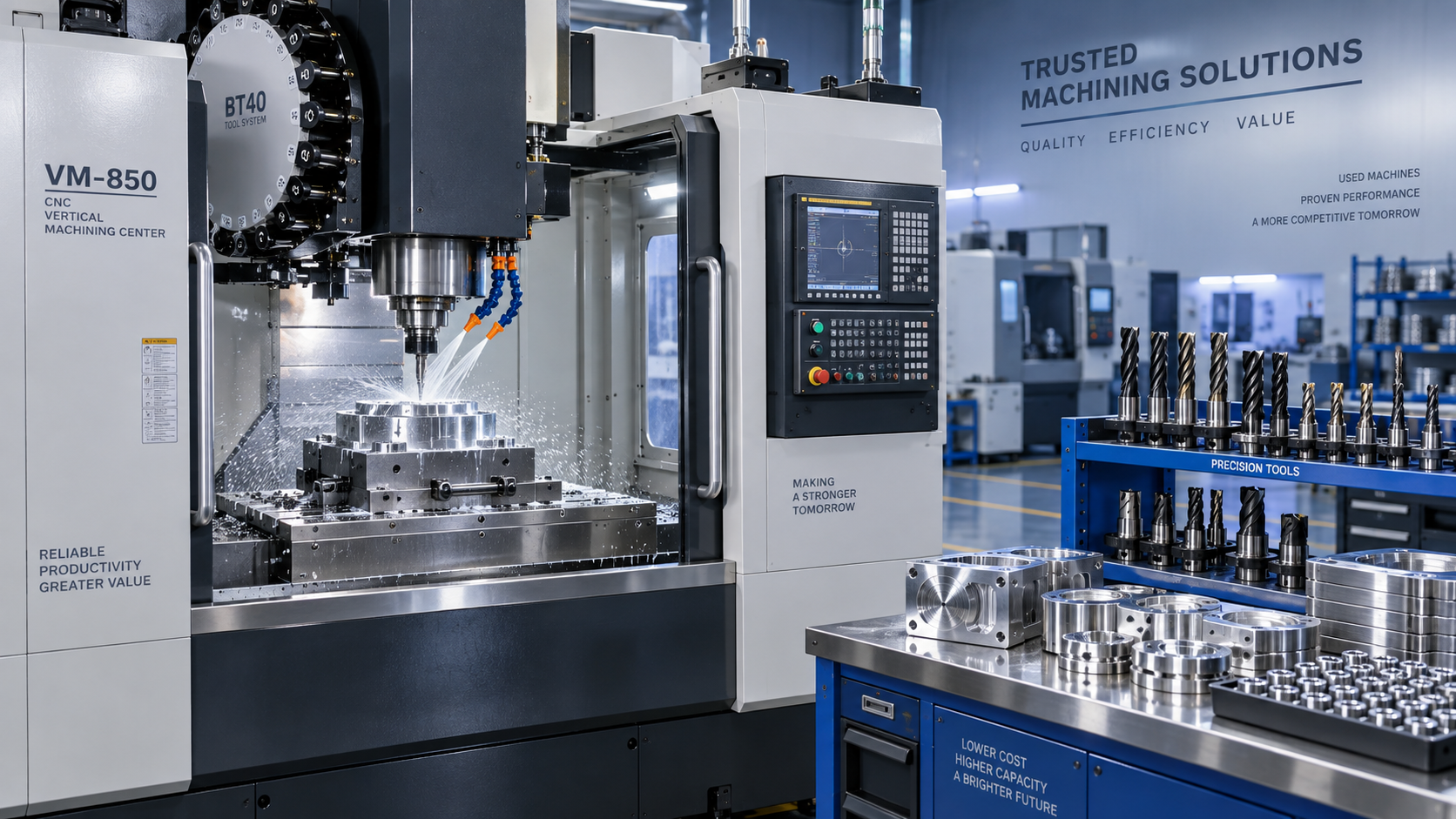
Condition evidence matters more than the machine's age
Age and hour-meter readings are useful signals, but neither proves the remaining value of a machine. A lightly used machine that stood idle in poor conditions may have lubrication, electrical, corrosion, or battery-related problems. A machine with more operating hours may remain a sound purchase if it received documented service, operated in a controlled environment, and has a history of producing comparable work.
Before approval, request evidence that allows the operations team to judge condition rather than relying on appearance. A disciplined review should cover the machine under power and, where possible, under a representative cutting load.
- Service and maintenance records, including spindle, ball screw, drive, lubrication, and control repairs.
- Axis backlash, repeatability, positioning behavior, and signs of servo instability.
- Spindle noise, vibration, runout, temperature behavior, and tool-change function.
- Condition of way covers, chip conveyors, coolant systems, enclosures, and electrical cabinets.
- Control age, software version, backup availability, and the ability to obtain replacement components.
- Evidence of a test cut using material and tooling close to the intended application.
- Availability of manuals, electrical diagrams, parameter backups, and machine-specific service support.
For finance approval, this information supports a more realistic contingency allowance. A used machine with a clear maintenance trail may warrant a modest repair reserve. A machine with uncertain history, unsupported electronics, or no practical test opportunity should be treated as a higher-risk asset, even if the asking price is attractive.
Downtime changes the decision faster than repair invoices do
Repair bills are visible, so they tend to receive attention. Lost production is often more costly and less visible in an initial comparison. A mill that fails during a non-critical period may create inconvenience. The same failure during a delivery-sensitive run can trigger overtime, subcontracting, schedule disruption, or missed revenue.
For that reason, used equipment offers its best value where the business can absorb a reasonable outage. This may mean there is another compatible machine on the floor, production can be rescheduled, or the purchased unit is not the sole source of a critical operation. When one machine must support a narrow delivery commitment with no backup, the warranty, service access, and predictable reliability of new equipment can justify a higher capital outlay.
Support should be evaluated as part of the asset, not as a separate purchasing detail. A lower-cost used machine may become difficult to maintain if its control components are obsolete, its original builder no longer supports the model, or qualified technicians are hard to access. In contrast, a common machine platform with readily available parts can retain commercial value well beyond its original sale date.
Do not confuse adjacent equipment with equivalent capacity
Cost pressure sometimes leads buyers to compare equipment that performs different operations. This can create a misleading capital case. A magnetic drill may be highly effective for portable holemaking on structural work, but it does not replace a machining center where the job requires interpolated features, precise datum relationships, milling operations, or repeatable multi-face machining.
For heavy-duty drilling work away from a fixed machine, equipment such as the Magnetic drill VDD60 can be relevant to the wider production plan. Its 15000N magnetic holding force, 1800W rated power, and drilling capacity up to 60mm address a distinct holemaking application. The financial benefit comes from assigning the right operation to the right asset, rather than loading a CNC mill with work that does not require milling precision.
That distinction matters in an approval model. A used milling machine may be the right investment for controlled, repeatable machining, while portable drilling equipment can reduce handling or setup costs on fabrication work. Treating them as substitutes would distort both utilization assumptions and return estimates.
A practical approval threshold
A used machine deserves serious consideration when its demonstrated condition matches the required work, the buyer can verify support and spare-part access, and the expected savings leave room for corrective maintenance. It is particularly compelling when the machine can use existing tooling and programming knowledge, enter production quickly, and operate alongside other capacity rather than becoming a single point of failure.
A new machine deserves the premium when production economics depend on warranty coverage, modern controls, automation readiness, difficult performance requirements, or consistently high utilization. In that situation, the higher purchase price may buy reduced operational uncertainty rather than simply newer equipment.
For finance approvers, the strongest request will therefore show more than a difference between used and new quotations. It will show the required output, the consequences of downtime, the evidence behind condition assumptions, and the point at which the used asset's lower capital cost remains a genuine advantage.
