




Does a lower milling machines price exclude essential tooling?
A lower milling machines price does not automatically mean essential tooling has been excluded, but it often means the quotation needs much closer reading. In machine-tool purchasing, the advertised base price may cover the machine structure, spindle, control, and standard electrical package while leaving out the items required to produce parts on the first day. The risk is not simply paying for extras. It is approving a budget based on a machine that is not yet production-ready.
For procurement teams, the useful question is: what work can this quoted machine complete immediately, using the tooling and services included in the offer? Two milling machines with a similar table size or spindle rating can have very different final acquisition costs once workholding, cutting tools, probing, chip management, commissioning, and operator preparation are included.
Read the quotation as a production package
A machine quote should be assessed in layers. The first layer is the machine itself: frame, axes, spindle, motors, CNC control, guarding, lubrication, and basic safety equipment. The second layer is the tooling and interface package that lets the buyer clamp a workpiece, hold cutters, establish work offsets, and verify dimensions. The third is the implementation layer, including transport terms, installation, machine leveling, commissioning, training, and service response.
A low milling machines price may be entirely reasonable when the buyer already has a compatible toolholder inventory, vises, fixtures, measuring equipment, and trained programmers. It becomes less attractive when the purchase is intended for a new production cell, a different taper standard, or a part family with demanding tolerances.
“Standard accessories included” is not sufficiently specific for a capital-equipment decision. Buyers should request an itemized inclusion list with quantities, makes or specifications where relevant, and a clear distinction between supplied, optional, and customer-provided items. This prevents a common problem: one side assumes a practical shop-ready configuration, while the other has priced only the minimum factory package.
Tooling omissions that change the real cost
The most consequential omissions are often not obvious in a headline quotation. Some are low-cost individually but essential to start work; others affect cycle time, capability, and scrap risk for years.
- Toolholders and pull studs: The spindle taper may be included, while the holders needed for end mills, drills, face mills, boring heads, and tapping tools are not. Check the taper type, retention-knob standard, holder balance requirement, and whether coolant-through holders are necessary.
- Workholding: A basic vise may be included, yet production may require additional vises, soft jaws, fixture plates, fourth-axis chucks, hydraulic clamping, or pallet interfaces. The required setup depends on part geometry and expected batch size.
- Probing and tool setting: A manual setup process can be acceptable for simple, low-volume work. For frequent changeovers, tight tolerances, or unattended cycles, spindle probes and tool setters may be commercially important even when listed as options.
- Coolant and chip handling: Standard flood coolant does not answer whether through-spindle coolant, high-pressure delivery, filtration, oil skimming, or chip conveyors are included. Material choice and cutter design determine whether these features are optional conveniences or operational requirements.
- Cutting tools: Cutting tools are usually excluded, but buyers should not treat them as a generic consumable line. The starter tool package must match material, hole depth, toolpath strategy, holder system, and target finish.
- Software and connectivity: A CNC control may be supplied with basic functions while conversational programming modules, probing cycles, offline programming software, remote monitoring, or data-collection interfaces require separate licenses.
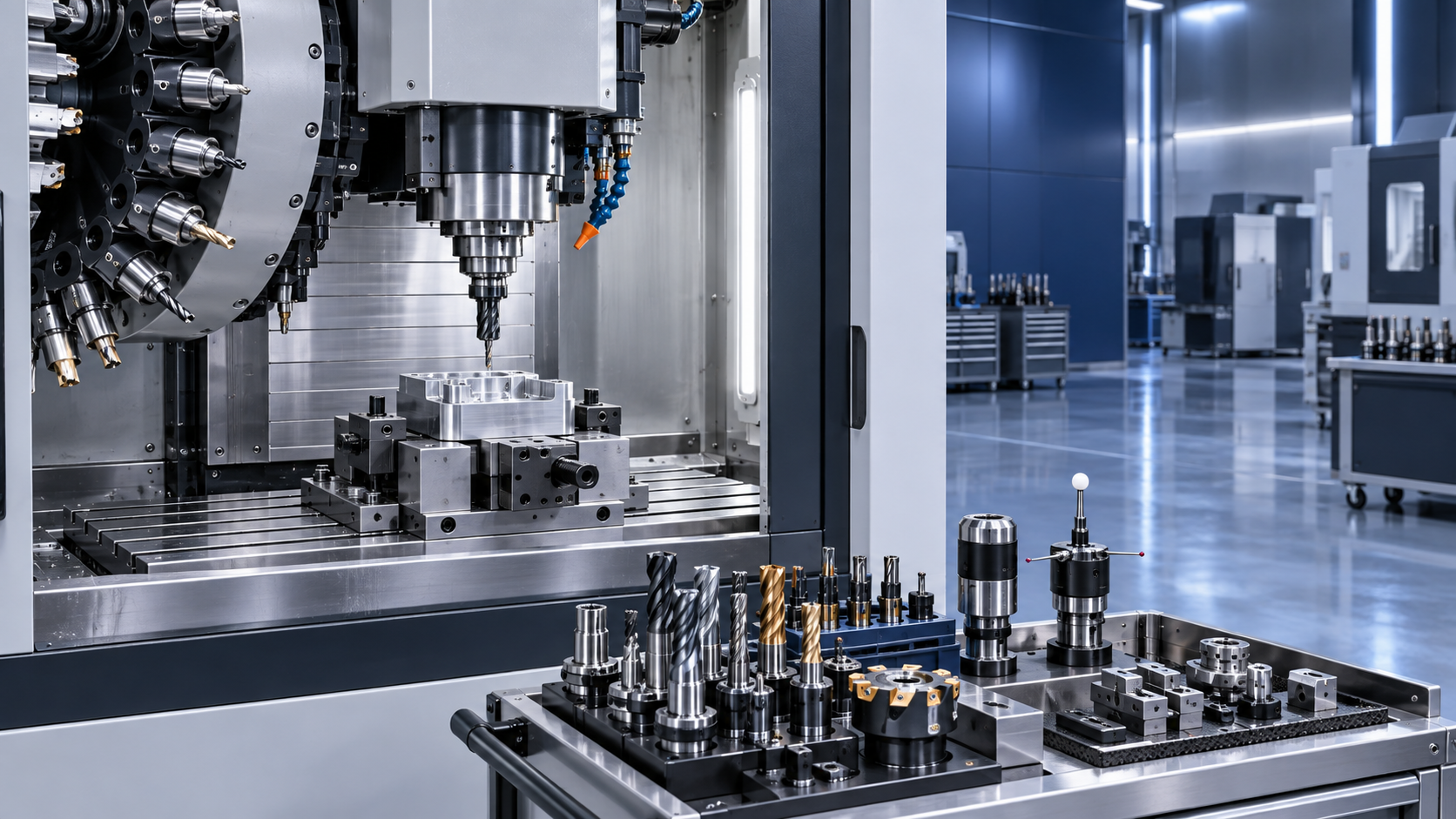
The practical effect of these gaps varies by application. A workshop machining simple aluminum brackets may begin with modest tooling. A supplier producing steel hydraulic components with multiple drilled features may need more robust clamping, drill holders, coolant support, in-process measurement, and dependable chip evacuation before the machine can meet its planned output.
Separate essential tooling from desirable upgrades
Procurement discussions can become unproductive when every option is described as necessary. A better approach is to classify each item by the part requirements and operating model.
This distinction also makes supplier comparisons more credible. Rather than demanding that every vendor include every possible accessory, provide the same part drawings, materials, annual volume assumptions, tolerance requirements, and intended shift pattern. Ask each supplier to quote a “ready for first approved part” configuration and identify any assumptions behind it.
When comparing offers, do not simply add option totals. Examine whether each option is integrated, warranted, and supported by the machine supplier. A separately sourced vise or toolholder may lower initial cost, but compatibility errors, delayed delivery, or unclear responsibility can consume the apparent saving.
Control system and service exclusions deserve equal attention
Tooling receives attention because it is visible, but control-system configuration can create a larger long-term constraint. A quote may name a CNC controller without stating its installed functions. Procurement should check axis count, spindle-control capability, memory capacity, networking, safety functions, probing support, and the availability of required machining cycles. For a buyer using existing programs, post-processor compatibility and operator familiarity also matter.
Installation terms need the same level of detail. A low price may be quoted ex works, excluding freight, insurance, import handling, inland transport, unloading, foundation preparation, electrical connection, commissioning, and training. None of these items is inherently improper to exclude. The issue arises when they are absent from the budget and appear only after the purchase order has been approved.
Service coverage should be read in operational terms. Establish who handles startup issues, what remote support includes, whether local field service is available, how replacement parts are supplied, and which failures are covered under warranty. A machine can be technically capable yet unsuitable for a production-critical role if support arrangements are vague.
Use adjacent equipment carefully in cost comparisons
Some purchasing teams compare every drilling or cutting need against a machining-center investment. That can obscure a simpler and less expensive solution for certain secondary operations. For example, structural steel fabrication or on-site metalwork may call for a compact magnetic drill rather than tying up a milling machine. A 50 mm-capacity unit such as the Magnetic drill VDG35 (Vitality Orange) illustrates the type of separate equipment that may suit industrial metal drilling when portability and magnetic holding force are relevant.
That does not replace a milling machine where positional accuracy, interpolation, complex profiles, or repeated precision are required. It does show why a lower machine quote should be judged against the actual operation list. Assigning straightforward drilling to suitable dedicated equipment can reduce pressure to specify unnecessary capability into the milling-machine package.
A clearer way to compare final investment
Before selecting a supplier, ask for a single comparison sheet that lists the base machine, included tooling, excluded tooling, site requirements, startup services, warranty scope, lead time, and recommended spare parts. Then add an internal line for fixtures, inspection, programming, operator time, and qualification work. The final number does not need false precision; it needs to reveal the difference between a delivered machine and a functioning process.
A lower initial price can be the right decision when exclusions are deliberate, compatible with existing resources, and unlikely to interrupt production. It is a warning sign when the quote leaves open how parts will be held, tools will be measured, chips will be controlled, or the machine will be commissioned. The strongest purchase decision is usually the one that makes those assumptions visible before the order is placed.
