


What Certifications Matter When Sourcing CNC Machine Tools
Which certifications actually matter when buying CNC machine tools?
For procurement teams, certifications are not just documents attached to a quotation. They are one of the fastest ways to judge whether a supplier has a real quality system, whether the machine can legally enter your target market, and whether the equipment is likely to perform consistently over time. When sourcing CNC machine tools, the most useful certifications usually fall into three groups: quality management, product safety, and market-specific compliance.
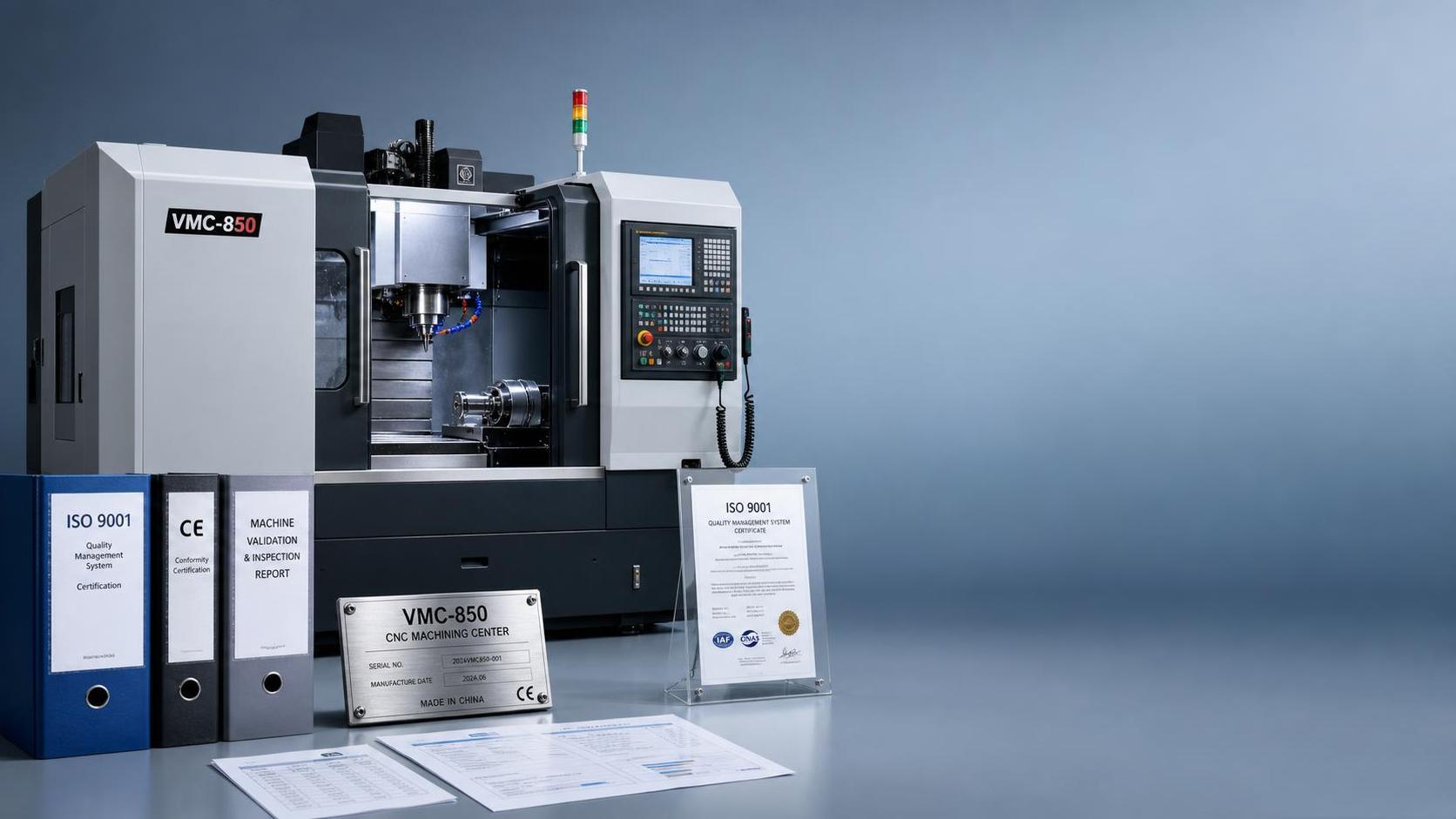
In practical terms, buyers usually start with ISO 9001 for the manufacturer’s quality management system, then check whether the machine carries the right product compliance marks for the destination market, such as CE for many European applications. After that, the important question is whether those certificates are relevant to the exact machine model being quoted, not just to the company in general.
Is ISO 9001 enough to qualify a CNC machine tool supplier?
No. ISO 9001 is useful, but it is only a starting point. It tells you the manufacturer has a documented quality management system. That matters because it suggests there are controlled processes for purchasing, production, inspection, corrective action, and traceability. For a buyer, that lowers the risk of random variation between batches or poorly handled nonconforming parts.
What ISO 9001 does not prove is that a specific CNC machine tool meets the safety or technical rules of your destination market. A supplier may hold ISO 9001 and still provide a machine that lacks proper guarding, incomplete electrical documentation, or the required conformity records. So treat ISO 9001 as evidence of process discipline, not as proof of full product compliance.
What does CE really tell a buyer?
CE matters when the machine is being placed on markets that require it. For procurement, CE is important because it signals that the equipment is claimed to meet applicable European requirements related to safety, health, and other regulated aspects. But buyers should not stop at the CE mark on the nameplate. That is where mistakes happen.
Ask for the supporting file set. A serious supplier should be able to provide:
- Declaration of Conformity
- User manual in the required language
- Electrical drawings
- Machine identification details matching the quoted model
- Relevant test or assessment records tied to the product
The key check is consistency. If the certificate names a different model, shows a different manufacturer, or uses generic wording that could apply to anything, the document is not doing much for your risk control.
Do all CNC machine tools need the same certifications?
Not at all. The required certification path depends on the machine type, the destination market, the electrical configuration, and how the equipment will be installed or integrated. A standalone machine may be assessed differently from a machine delivered as part of an automated production line. The buyer’s job is to match the paperwork to the actual transaction.
That is why procurement should avoid broad requests like “send all your certificates.” A better request is model-specific and market-specific: send the compliance documents for this exact machine, this voltage, this control configuration, and this destination country. That phrasing usually reveals very quickly whether the supplier understands export compliance or is only forwarding generic files.
How can buyers tell whether a certificate is relevant to the quoted machine?
Check the details that are easy to overlook. Procurement teams often focus on whether a certificate exists, while the real issue is whether it matches the machine being purchased.
This same discipline applies even to smaller industrial equipment. If you are reviewing a drilling unit for metalworking, for example, the compliance file should still line up with the exact configuration being ordered. A product such as Magnetic drill VDG60 may look straightforward on paper, but buyers still need the documentation to match the model, rated voltage, and intended market.
Are third-party test reports the same as certification?
No, and mixing those up leads to bad purchasing decisions. A test report usually shows that a sample was tested against specific criteria at a certain time. Certification, depending on the scheme, can involve a broader claim about conformity, system control, or ongoing surveillance. One is not automatically a substitute for the other.
If a supplier sends a lab report, read what exactly was tested. Was it the entire machine, the electrical cabinet, or just one component? Was the report issued for the same model family? Procurement should treat test reports as supporting evidence, not as a shortcut around missing product compliance documents.
What documents should be on a buyer’s checklist besides certificates?
A sound purchasing review for CNC machine tools usually includes more than the certificate file. Buyers should also ask for the machine specification sheet, inspection records, packing list format, spare parts list, manual, and warranty terms. These documents help verify whether the certified or declared machine is the same one that will actually be delivered.
This is especially useful when comparing suppliers whose claims look similar. One vendor may provide broad statements about quality, while another gives a cleaner document package with traceable model data and consistent technical parameters. The second supplier is usually easier to manage after shipment as well.
Where do procurement teams usually make mistakes?
Three errors show up again and again. First, accepting a company certificate as if it proves product compliance. Second, reviewing only the first page of a document and missing a scope mismatch. Third, leaving compliance review until after price negotiation, when lead time pressure makes it harder to challenge gaps.
Another common issue is treating all metalworking equipment the same. For example, if a buyer is sourcing a compact drilling solution with a 50mm maximum drilling diameter, 1500W rated power, and 220V input, the documentation review still needs to be as disciplined as it would be for larger CNC machine tools. Smaller footprint does not mean lower compliance risk.
What is the best practical approach before placing the order?
Use a short verification sequence tied to the purchase order stage:
- Define the destination market and installation scenario.
- Request model-specific certificates and compliance documents.
- Match the documents against the quotation, nameplate data, and technical sheet.
- Check whether the supplier’s quality system certificate is current and relevant.
- Make document acceptance part of the order release process, not a post-shipment task.
A useful rule for buyers is simple: do not ask only whether the supplier is certified. Ask whether this exact machine, in this exact configuration, has the documents required for this exact market. That question is usually where a reliable sourcing decision starts.
