


How to verify spare-parts continuity from a milling machines manufacturer
How to Verify Spare-Parts Continuity from a Milling Machines Manufacturer
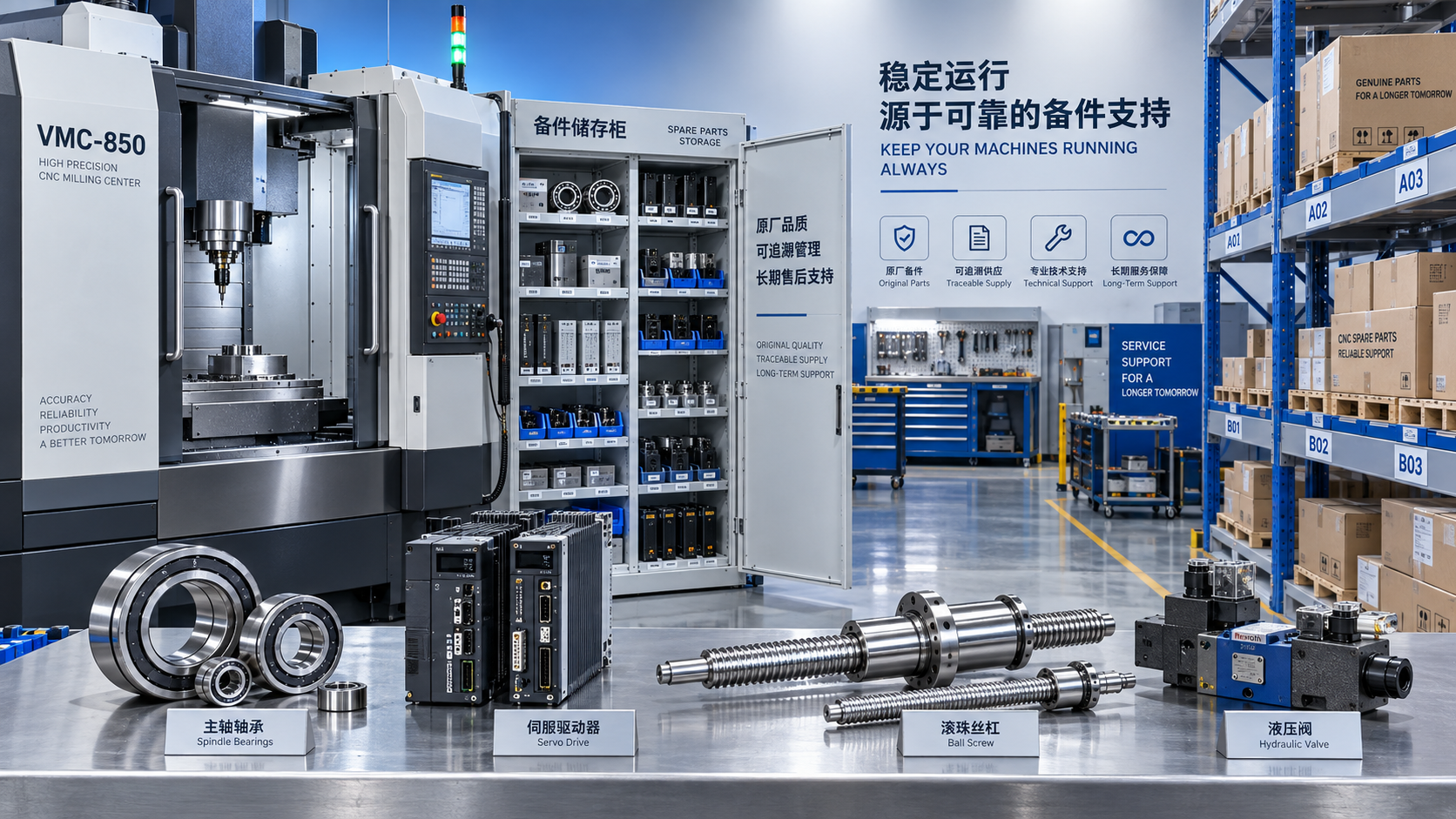
For maintenance teams, spare-parts continuity determines whether a milling machine remains productive or becomes an extended downtime risk after a single component failure.
Before choosing a milling machines manufacturer, verify its inventory planning, part traceability, service response process, and documented commitment to long-term machine support.
A dependable supplier provides more than machine specifications. It must keep critical components, service documents, compatible replacements, and practical technical assistance available throughout the machine lifecycle.
Start with the Parts That Can Stop Production
Do not begin by requesting a generic spare-parts catalog. Start by identifying the components whose failure would immediately stop machining operations on your floor.
Typical production-stopping items include spindle bearings, servo drives, CNC controllers, ball screws, hydraulic valves, lubrication pumps, encoders, contactors, and safety interlocks.
Maintenance personnel should also consider wear items with predictable replacement cycles, including belts, seals, filters, limit switches, coolant components, and tool-clamping parts.
Ask the milling machines manufacturer to classify recommended spare parts into critical, operational, consumable, and long-lead-time categories for each machine configuration.
A useful critical-parts list includes the exact part number, manufacturer name, expected service life, replacement procedure, inventory recommendation, and normal procurement lead time.
This information helps maintenance teams distinguish between inexpensive routine consumables and components that require pre-purchase because replacement may take several weeks.
Pay particular attention to proprietary electrical boards and machine-specific mechanical assemblies. These parts can be difficult to source through local distributors when equipment ages.
Check Whether Part Numbers Are Traceable and Stable
Part traceability is one of the clearest indicators of whether a supplier can support equipment after installation, relocation, upgrades, or years of continuous operation.
Each machine should have a serial number linked to a bill of materials, electrical schematic, hydraulic diagram, assembly drawing, and revision-controlled spare-parts list.
Ask how the manufacturer handles design changes. A revised component should have a clear supersession record explaining whether it directly replaces an earlier version.
Without revision control, maintenance teams may receive a physically similar part that cannot communicate correctly with the controller or fit the existing assembly.
Request sample documentation before purchasing. It should show machine model, serial-number range, part code, description, quantity, source, and compatibility notes.
Reliable suppliers can identify parts from photographs, serial plates, or technical drawings, but formal part numbers remain essential for accurate ordering and stock control.
Also confirm whether the milling machines manufacturer records major optional configurations. Different spindle packages, controllers, motors, or automation systems can require different replacement parts.
Evaluate Inventory Policy Instead of Accepting “Available”
The word “available” has limited value unless the supplier explains where the part is stored, whether it is physically stocked, and when it can ship.
Ask for inventory evidence covering critical spares. This may include warehouse locations, stock quantities, replenishment policy, historical demand, and target fulfillment times.
A manufacturer may keep common items in regional warehouses while sourcing specialized assemblies from its factory. Both approaches can work when lead times are transparent.
For high-value electronics, suppliers sometimes hold service exchange units rather than large new-part inventories. Confirm testing standards, warranty terms, and exchange conditions.
Request lead-time ranges for three situations: stocked parts, factory-made parts, and obsolete or redesigned components. Planning around best-case estimates creates unnecessary exposure.
Maintenance teams should compare those timelines with their own production tolerance. A two-week spindle lead time may be manageable for one plant but unacceptable for another.
Where production is highly constrained, negotiate a customer-held spare-parts package. The package should be selected using failure impact, consumption rate, and supplier lead-time data.
Test Service Response Before You Need Emergency Support
A strong parts program loses value if service personnel cannot diagnose failures quickly. Verify the supplier’s support process before signing the purchase agreement.
Ask who receives urgent service requests, which languages are supported, what hours the team operates, and how technical cases are escalated after initial troubleshooting.
Clarify whether remote support is included. Secure video assistance, controller diagnostics, alarm interpretation, and guided electrical checks can reduce downtime before parts even arrive.
Request typical response metrics rather than broad promises. Useful figures include first-response time, average diagnosis time, order-confirmation time, and dispatch time for stocked items.
Ask whether field engineers are available in your region and whether they carry common service parts. Local coverage matters when failure analysis requires onsite measurement.
Technical documentation should be usable by maintenance staff, not only factory engineers. Ensure manuals include alarm lists, wiring diagrams, lubrication schedules, and component replacement instructions.
A supplier that offers structured training can reduce repeat failures. Training should cover preventive inspections, alarm diagnosis, alignment checks, and correct handling of sensitive electronic components.
Verify Long-Term Support Through Contractual Evidence
Long-term support claims should be written into commercial documents whenever possible. Verbal assurances do not provide a dependable basis for maintenance planning or capital approval.
Ask the manufacturer to state its intended support period for mechanical parts, electrical parts, software, and controller-related components after final machine delivery.
Where full availability cannot be guaranteed, request an obsolescence-management process. The supplier should provide advance notice, replacement options, retrofit guidance, and pricing expectations.
For CNC controls, determine whether software backups, parameter files, PLC programs, and machine-specific configuration records will be supplied and maintained securely.
Confirm ownership and access rights for essential files. A machine can be mechanically repairable yet remain idle if the required parameters or ladder program are unavailable.
Review warranty exclusions carefully. Some suppliers cover defective replacement parts but exclude labor, travel, expedited shipping, consumables, or installation-related damage.
For multi-site operations, establish a single support contact and consistent ordering process. Centralized records make it easier to track recurring failures and optimize stocked inventory.
Use Adjacent Equipment Support as a Practical Reference
When assessing a supplier’s broader service discipline, examine how it supports other equipment lines, including saws, automation systems, cutting tools, and workshop machinery.
For example, a supplier offering the Band Saw Machine GH4235 should be able to clarify blade specifications, hydraulic parts, coolant-pump components, and compatible service items.
Its GH4228, GH4235, GH4240, and GH4250 configurations use different cutting capacities, dimensions, motor outputs, and blade-related requirements, making accurate identification important.
This is relevant because good service practices transfer across product categories. Clear model records, accessible documents, and defined replacement procedures indicate operational discipline.
However, do not assume broad product availability automatically proves milling-machine support. Request separate evidence for the exact milling model, controller, spindle, and options you intend to buy.
Create a Pre-Purchase Spare-Parts Verification Checklist
Before issuing a purchase order, organize the supplier’s answers into a checklist that can be reviewed by maintenance, production, procurement, and engineering stakeholders.
First, confirm that the machine serial-number system connects to complete drawings, software records, electrical diagrams, hydraulic diagrams, and a revision-controlled bill of materials.
Second, obtain a recommended startup-spares list with quantities, prices, storage conditions, replacement intervals, and criteria for replenishing customer-held inventory.
Third, document normal and emergency lead times for every critical item. Include freight assumptions, export documentation, customs risk, and available expedited-shipping options.
Fourth, verify support routes by testing the contact channels. A pre-sales response should not be treated as proof that the after-sales organization can resolve technical breakdowns.
Finally, establish a regular review schedule after commissioning. Parts usage, recurring alarms, machine age, and production changes should update your spares strategy over time.
Conclusion
Spare-parts continuity is not confirmed by a catalog or a general support statement. It is verified through traceable part data, stocked inventory evidence, responsive technical service, and written commitments.
For maintenance teams, the best milling machines manufacturer is one that helps prevent downtime before a failure occurs and provides clear recovery options when one does.
Use documented parts lists, realistic lead times, support tests, and lifecycle commitments to turn supplier evaluation into a measurable maintenance-risk decision.
