


How to Choose a Gantry Machining Center for Large Part Accuracy
Start with the accuracy target, not the machine brochure
When you are evaluating a Gantry machining center for large parts, the real question is not whether the machine looks heavy enough or has a long feature list. The question is whether it can hold the accuracy your part actually needs after hours of cutting, repositioning, and temperature change. That is where many selections go wrong. A machine may look strong on paper and still become difficult to control once the workpiece gets large, the cycle gets long, or the tolerance stack starts affecting assembly.
For technical evaluators, the most useful approach is to work through the decision in the same order the risk shows up on the shop floor: part requirement first, then structure, then motion accuracy, then control behavior, then application fit. If you reverse that order, you usually end up comparing catalog numbers instead of judging machining stability.
Check the part before you check the machine
Start with the envelope of the real job. Overall part size matters, but unsupported span, wall thickness, datum layout, and clamping distortion matter more. A large welded frame behaves very differently from a cast base or a thick steel plate. If the part moves during release or heat input, the Gantry machining center will be blamed for an error that actually started in the workpiece.
- Define the tightest tolerances by feature, not by drawing headline.
- Separate positional accuracy, flatness, perpendicularity, and surface finish requirements.
- Map which dimensions must be finished in one setup and which can tolerate transfer error.
- Review material removal volume. Heavy roughing and fine finishing do not stress the machine in the same way.
That last point is easy to underestimate. If one machine must rough aggressively and finish critical faces in the same cycle, rigidity and thermal control move much higher on the priority list.
Look hard at structural rigidity where errors actually come from
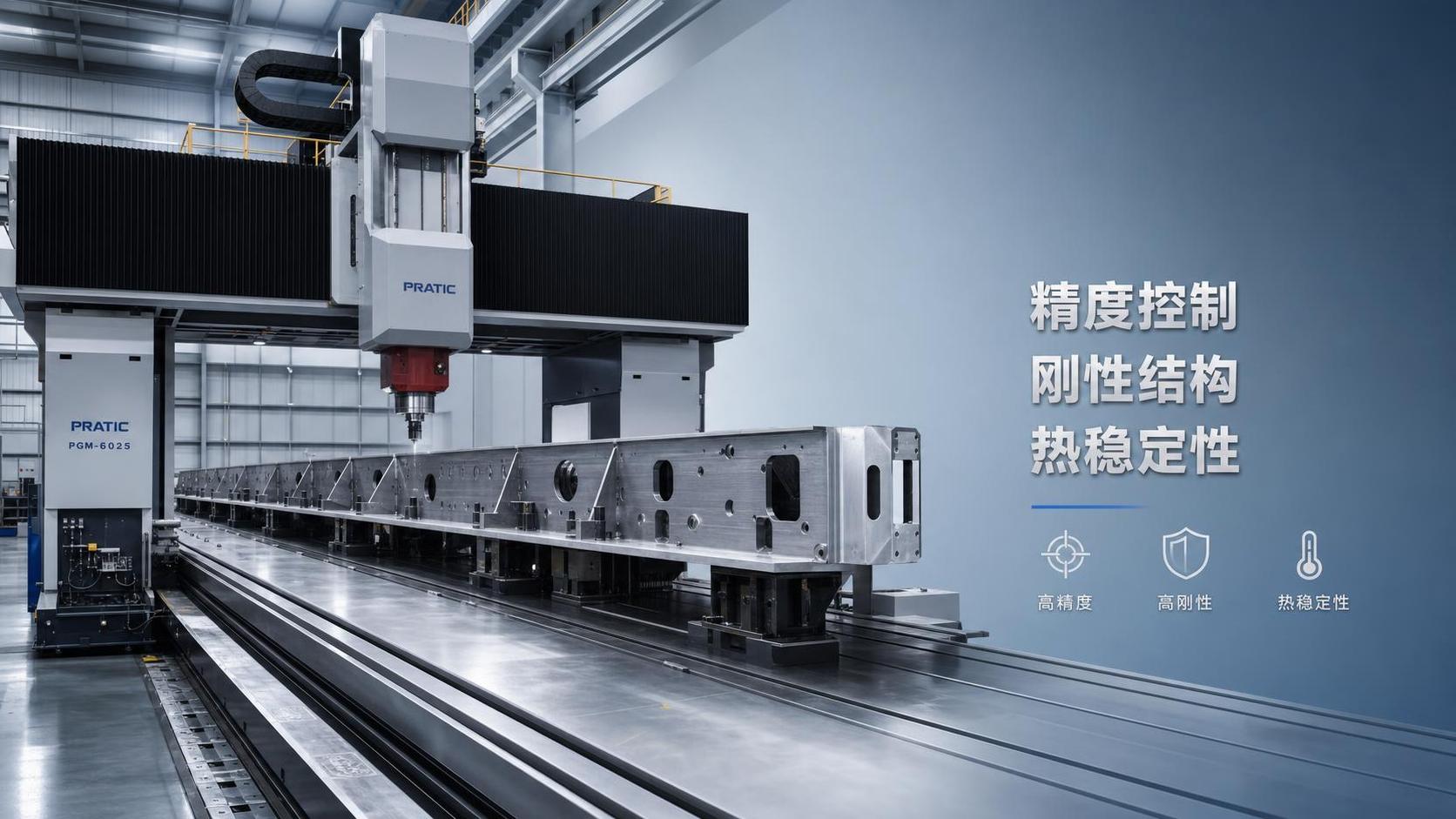
On large-part work, accuracy loss usually comes from deflection, vibration, or thermal drift before it comes from nominal axis resolution. So do not stop at axis travel and spindle power. Ask how the crossbeam, columns, ram, saddle, and table carry load under actual cutting conditions.
A common mistake is choosing a machine with enough working envelope but a weak ram extension condition. The farther the tool point moves away from the support structure, the more leverage small stiffness losses create. If your parts require deep cavity access or extended tool projection, evaluate the machine in that exact condition, not in a short-tool demo setup.
Useful questions to ask during evaluation:
- What is the machine configuration during the most demanding cut?
- How much ram extension is expected at that moment?
- Will the work sit near the center of the table or near the travel limit?
- Are the target tolerances still realistic after tool length, fixture height, and part geometry are added?
Thermal stability deserves its own decision line
For long-bed and large-structure machining, thermal behavior can quietly override a machine’s geometric accuracy. Spindle heat, ambient variation, coolant temperature swing, and even uneven morning warm-up can move a large structure enough to affect fit-up dimensions. If your critical features are spread over a long distance, this is not a minor detail.
You do not need vague claims about stability. You need to know how the builder manages heat in the spindle, feed system, and structure, and whether the machine control supports compensation strategies suited to your process. Also review where the machine will live. A Gantry machining center installed in a tightly controlled environment is a different proposition from the same machine working near open doors, heavy crane traffic, or variable summer heat.
Do not confuse positioning specs with process accuracy
Technical buyers often get handed positioning and repeatability values early in the discussion. Those numbers matter, but they are not the whole story. Large-part accuracy depends on the combined behavior of axes, spindle, toolholding, fixturing, probing, compensation, and the part itself.
Match the spindle and feed behavior to the real job mix
A machine chosen for large aluminum plates will not be judged the same way as one cutting steel weldments or heavy mold bases. Spindle speed range, torque behavior, feed smoothness at low speed, and acceleration under mass all need to fit the process. This is where application fit becomes more important than broad “high-performance” language.
In some production lines, the Gantry machining center is not working alone. Supporting operations such as drilling or secondary hole preparation may still be handled on dedicated equipment. In that context, a machine like Radial Drilling Machine Z3050 can make sense for separate drilling tasks where its 50 mm maximum drilling capacity, 32-2500 rpm spindle speed range, and 350-1600 mm spindle-to-column reach fit the workflow. The point is not to compare unlike machines, but to avoid overloading the gantry platform with work that may be better done elsewhere.
Evaluate fixturing and table use early
Large-part accuracy is heavily affected by how the part is supported. If the fixture plan is still vague during machine selection, you are missing a major variable. Check table load distribution, clamping zones, chip evacuation around supports, and how easily the operator can indicate datums and reach clamps. A machine that looks ideal in a clean layout drawing may become awkward once real fixtures and crane access enter the picture.
Watch for another common trap: buying extra travel that the plant cannot use efficiently. Longer travel is not automatically better if fixture setup becomes harder, thermal exposure increases, and the work spends most of its time in one smaller zone anyway.
Review the control around the operator’s actual job
The control should support the work, not just the machine. For large precision parts, that usually means practical probing routines, clear coordinate management, recovery after interruption, and stable execution of long programs. If the process includes multiple part families, setup management and offset discipline become part of accuracy control, not just convenience features.
Ask how the supplier expects users to verify machine condition over time. Not with sales language, but with a defined maintenance and inspection routine tied to geometry, backlash behavior, lubrication, and spindle condition. If that discipline is missing, long-term accuracy will drift no matter how good the machine looked at acceptance.
What usually separates a good selection from an expensive mistake
The best selections are usually made by narrowing the decision around three things: the worst-case part condition, the longest continuous cycle, and the most demanding tolerance chain. Once those are defined, you can judge whether the Gantry machining center has enough structural margin, thermal control, and process support to hold accuracy consistently rather than occasionally.
A practical decision sequence is simple. Freeze the critical part requirements. Review machine stiffness in the actual cutting posture. Check thermal management against your shop environment. Confirm how accuracy will be maintained across the full work zone, not just near a preferred position. Then review how fixturing, probing, and adjacent machines fit the overall process. That order tends to expose weak matches early, before a specification sheet turns into a costly commitment.
