


How Automation Trends Are Changing CNC Machine Tools Selection
How Automation Trends Are Changing CNC Machine Tools Selection
The biggest mistake in selecting CNC machine tools today is treating automation as an optional add-on. For technical evaluators, that view is already outdated. A machine may still meet dimensional accuracy and spindle power targets, yet fall short in production because it cannot exchange data cleanly, support unattended cycles, or maintain process consistency across variable batches. In other words, the selection question has shifted from “Can this machine cut the part?” to “Can this machine stay productive inside an automated manufacturing flow?”
That shift matters because automation is no longer limited to large, highly standardized plants. Even mid-sized workshops are adopting pallet changers, robotic loading, tool life monitoring, digital work instructions, and remote diagnostics. Once those systems are in place, CNC machine tools are judged less by isolated specifications and more by how well they behave as connected production assets. This changes what counts as a strong machine tool choice.
A good example is control architecture. In the past, buyers often focused on axis configuration, travel, rigidity, and cutting speed first, then looked at the control as a secondary matter. Automation reverses some of that priority. If the controller cannot communicate reliably with MES, ERP, probing systems, tool presetters, or robotic cells, the machine becomes harder to schedule and harder to scale. Open communication protocols, stable software support, alarm traceability, and usable data output are now part of machine capability, not peripheral features.
This is where some evaluations go wrong. A machine with strong mechanical performance but limited integration may still be the right fit for simple job shop work. But for facilities planning lights-out operation or mixed-volume production, weak connectivity can create hidden labor cost and avoidable downtime. The machine still cuts metal; the system around it loses efficiency.
What Automation Changes in Practical Evaluation
Automation pushes selection toward repeatability, recoverability, and visibility. Repeatability is not just geometric precision. It also includes consistent tool change behavior, thermal stability over long cycles, probe reliability, and predictable chip evacuation. Recoverability means the machine can resume production with minimal disruption after a tool break, operator intervention, or upstream delay. Visibility refers to what the evaluator can actually monitor: machine status, cycle data, alarm history, tool wear signals, and maintenance indicators.
These factors become more important as operator attention is spread across more equipment. In a manual environment, an experienced machinist may compensate for a weak user interface or inconsistent setup behavior. In an automated cell, the machine must be easier to trust. It has to communicate clearly, hold process stability longer, and allow faster diagnosis when something drifts.
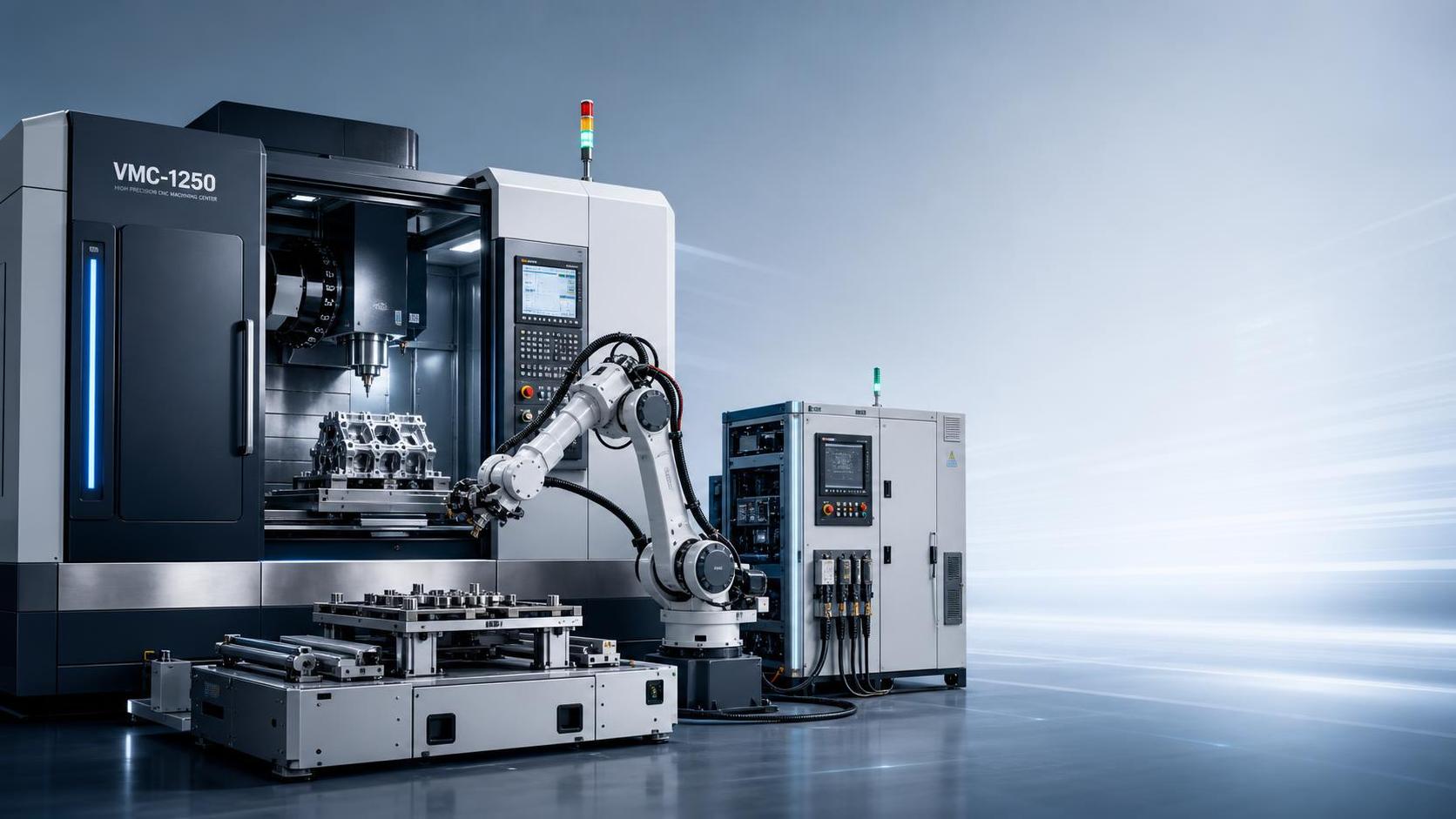
Another trend is shorter product life cycles and more frequent model changes. That has reduced the value of machines optimized for only one stable production pattern. Flexible workholding, fast program changeover, intelligent offsets, in-process measurement, and tool library management are becoming more relevant than raw peak performance alone. A slightly slower machine with smoother changeovers and fewer setup errors may produce more usable output across a month than a faster machine that is difficult to reconfigure.
Common Misreadings During Selection
One common misunderstanding is to equate automation readiness with the presence of a robot interface. That is too narrow. A CNC machine tool can have a robotic loading port and still perform poorly in automated production if maintenance access is awkward, chips accumulate unpredictably, or the alarm logic is too opaque for rapid troubleshooting. Automation readiness is really a combination of mechanics, controls, software behavior, and serviceability.
Another is overvaluing headline specifications without checking process boundaries. High spindle speed, for example, says little on its own about whether the machine will hold tolerance over extended unattended runs. The same is true for tool magazine size. More tool stations help only if tool management, tool life tracking, and change reliability are strong enough to support actual production logic.
Technical evaluators also need to separate “smart” features from useful ones. Dashboards and monitoring screens look impressive, but the real question is whether those functions help reduce setup risk, detect abnormal wear, or improve scheduling decisions. If data cannot be trusted or acted upon, it does not materially improve selection value.
A More Useful Selection Framework
When automation is part of the production roadmap, CNC machine tools should be screened against a broader set of criteria:
This broader view is increasingly relevant for suppliers working across precision machining and intelligent manufacturing environments. Companies such as Shandong Honcan Machinery Equipment Co., Ltd., which operate at the intersection of CNC equipment, industrial cutting tools, and manufacturing system integration, are responding to the same market pressure: buyers want machine tools that fit into production systems, not isolated machines with attractive catalog numbers.
That logic applies even outside full CNC machining centers. In industrial drilling and tapping work, for instance, buyers are also looking more closely at stability, force control, and suitability for structured workflows. A machine such as Magnetic drill VD338, with a 38 mm maximum drilling diameter, 1800 W rated power, 16000 N suction force, and 220 mm stroke, illustrates how selection is increasingly tied to operational reliability rather than a single headline parameter. For evaluators, those numbers are meaningful only when matched to actual application conditions, duty cycle, and setup demands.
What This Means for Technical Evaluators
The selection of CNC machine tools is becoming less about choosing the most advanced machine on paper and more about choosing the machine with the fewest operational contradictions. A technically strong platform should match the plant’s automation maturity, operator skill structure, production mix, and data environment. If one of those elements is misaligned, the machine may still run, but it will not run as effectively as expected.
A practical evaluation therefore needs a few hard questions. Can the machine maintain stable output when supervision is reduced? Can it exchange useful production data with the rest of the factory? Does the builder support long-term control updates and diagnostics? Are setup and recovery routines realistic for the actual shift pattern? These are no longer secondary concerns. They are now part of the core logic behind machine tool selection.
Automation is not making conventional criteria irrelevant. Accuracy, rigidity, power, and reliability still matter. What has changed is the context around them. For technical evaluators tracking market direction, the right CNC machine tools are the ones that combine machining performance with system compatibility, process transparency, and enough flexibility to remain useful as production methods keep changing.
